Vitamix blender wattage typically ranges from about 1,100 to 2,400+ watts, depending on the model and generation. The key is understanding the difference between “peak horsepower” marketing and actual continuous power draw. Higher wattage generally means more power for harder ingredients and faster blending, but other design factors like blade geometry and motor control are equally crucial for performance. Choosing the right model depends on your specific blending tasks, not just chasing the highest watt number.
So, you’re in the market for a Vitamix. You’ve heard the legendary tales of its blending prowess—turning whole fruits and vegetables into silky-smooth nectar in seconds, transforming ice into snow-like consistency, and making nut butters so creamy you’d swear they came from a jar. And then you see it: the spec sheet. Watts. Horsepower. What does it all mean? How many watts is a Vitamix, really, and why should you care? Let’s cut through the marketing noise and break down exactly what those numbers mean for your countertop and your smoothie bowl.
First, a quick truth: there is no single answer. “Vitamix” isn’t one blender; it’s a family of high-performance machines spanning different generations and series, each with its own motor specifications. Asking “how many watts is a Vitamix” is like asking “how many horsepower is a car?” It depends entirely on the model. But don’t worry—we’re going to map the entire landscape, from the workhorse Legacy models to the smart, sensor-driven Ascent series. By the end, you’ll know precisely what wattage means for blending power, which Vitamix models pack what punch, and how to choose the right one for your kitchen, not just the biggest number on the box.
Key Takeaways
- Wattage Varies by Model: Vitamix blenders span from ~1,100 watts in some Legacy models to over 2,400 watts in top-tier Ascent series, with most modern home models between 1,300–1,800 continuous watts.
- Peak vs. Continuous Watts: Vitamix often advertises “peak horsepower” (a short burst), but the more relevant figure is continuous wattage—the sustained power the motor can handle without overheating.
- Power Enables Performance: Higher wattage allows a Vitamix to effortlessly crush ice, grind nuts into butter, and blend large, dense batches without stalling or straining the motor.
- Not the Only Factor: Blade design, container shape, motor control algorithms, and overall engineering are as important as raw wattage for achieving smooth results and durability.
- Most Users Need 1,300+ Watts: For typical smoothies, soups, and nut butters, any modern Vitamix (starting around 1,300 continuous watts) will excel. The highest watt models are for commercial-level or very frequent, heavy-duty use.
- Wattage Affects Noise & Longevity: More powerful motors often run more efficiently under load (less strain) and can contribute to long-term reliability, though they may be louder at top speed.
- Check the Specs for Your Model: Always refer to the official Vitamix website or manual for your specific model’s exact specifications, as marketing terms can be confusing.
📑 Table of Contents
- The Heart of the Beast: Understanding Blender Wattage & Horsepower
- Vitamix Wattage Breakdown: From Legacy to Ascent
- What Does That Wattage Actually Do? Real-World Performance
- Beyond the Watts: The Other Pillars of Vitamix Performance
- Which Vitamix Wattage Is Right For You? A Practical Guide
- Conclusion: Power, Purpose, and the Vitamix Promise
The Heart of the Beast: Understanding Blender Wattage & Horsepower
Before we dive into specific models, we need a quick, painless lesson in blender power metrics. This knowledge is your secret weapon for cutting through confusing spec sheets.
Watts vs. Horsepower: The Conversion You Need to Know
In the world of blenders, power is measured in two ways: watts (W) and horsepower (hp). They are directly convertible: 1 horsepower equals approximately 746 watts. You’ll see Vitamix and other brands advertise “peak horsepower” (PHP) or “peak watts.” This is the maximum power the motor can output for a very short burst—a few seconds—when starting up with a full, dense container. It’s a useful indicator of the motor’s ultimate strength and torque potential.
However, the more important and honest figure is continuous watts or continuous horsepower (CHP). This is the amount of power the motor can sustain indefinitely without overheating or wearing out prematurely. It’s the real-world, long-term workhorse number. A blender with a 2.0 PHP motor might only have a 1.5 CHP rating. Vitamix is generally transparent about this, often listing “Input Power (Watts)” in their official specs, which is closer to the continuous draw. When you see a Vitamix listed at, say, 1,380 watts, that’s typically its continuous power consumption under load.
Why Wattage Isn’t Everything (But It’s a Lot)
It’s tempting to believe that the blender with the highest wattage is automatically the best. And while more watts generally mean more grunt, it’s not the sole determinant of performance. A high-watt motor paired with poorly designed blades, a suboptimal container shape, or weak motor controls can still produce mediocre results. Think of it like a race car: you need a powerful engine (watts), but you also need a great chassis, aerodynamics, and a skilled driver (blade design, container engineering, and control systems) to win the race. Vitamix’s reputation is built on the entire system working in harmony, not just a powerful motor. That said, wattage is the engine, and without sufficient power, the best blades in the world will struggle with tough jobs like grinding dried beans or crushing large ice cubes.
Vitamix Wattage Breakdown: From Legacy to Ascent
Now, let’s get specific. We’ll group Vitamix’s current and recent past models into their main families, detailing their typical power ranges. Remember, exact specs can vary slightly by regional model number (e.g., 5200 vs. 5200C), so always double-check for your exact unit.
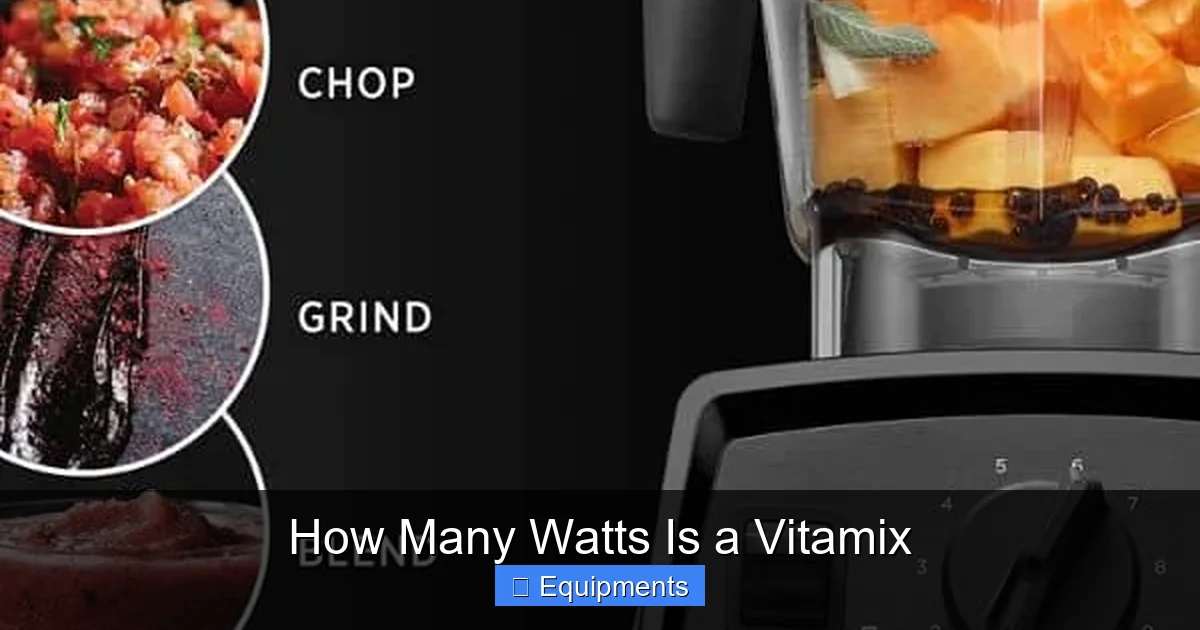
Visual guide about How Many Watts Is a Vitamix
Image source: rootsandbulbs.com
The Workhorse Legacy Series: Proven Power
These are the classic, no-frills Vitamix blenders that built the brand’s reputation. They feature a simple on/off switch and a variable speed dial. They are incredibly durable and powerful by any standard.
- Vitamix 5200 / 5300 / 6300: The iconic model. Its motor is rated for 1,380 continuous watts (about 1.8 peak horsepower). This is more than enough to handle any home blending task with ease. The 5200 is the benchmark.
- Vitamix 7500 / Professional Series 750: A more powerful evolution of the Legacy line, featuring a more powerful motor and a pulse feature. It typically boasts 1,800+ continuous watts (2.4+ peak horsepower). This extra grunt makes it slightly more efficient with very large, dense batches and gives it a bit more margin when tackling rock-hard ingredients.
- Vitamix Classic Series (like the S30): The smaller, personal-sized blenders. Their motors are less powerful, usually in the range of 900–1,100 continuous watts. They are fantastic for single-serve smoothies and smaller jobs but will struggle with large volumes of frozen ingredients compared to the full-size models.
The Smart & Sensor-Driven Ascent Series: Power with Precision
The Ascent series is Vitamix’s flagship modern line, featuring self-detecting containers, wireless connectivity, and pre-programmed settings. Their motors are highly advanced and powerful.
- Vitamix Ascent A2300 / A2500i / A3300: These models share a common, very powerful motor platform. They are rated for 2.2 peak horsepower, which translates to roughly 1,600–1,800 continuous watts under typical load. The motor control is incredibly sophisticated, using sensors to adjust torque in real-time, which makes it feel even more powerful and consistent than the raw number might suggest, especially when using programs.
- Vitamix Ascent Pro (A3500): This is the top of the home line. It features an even more robust motor, officially rated at 2.4+ peak horsepower. Its continuous power draw is likely in the 1,800–2,000+ watt range, making it the most powerful consumer Vitamix available. It’s designed for the heaviest daily use and largest batches.
The Explorian Series: Value-Powered Performance
Vitamix’s more affordable line (like the E310 and E320) still delivers legendary power but in a slightly different design package (different container locking system).
- Vitamix Explorian E310: The entry point into full-size Vitamix power. Its motor is rated at 1,400 continuous watts (about 1.9 peak horsepower). For most users, this is an immense amount of power that will never feel inadequate.
- Vitamix Explorian E320: A step up with a larger 64-oz container and a more powerful motor. It’s rated for 1,800+ continuous watts (2.4+ peak horsepower), essentially matching the power of the high-end Legacy 7500.
To put this in perspective: a typical high-end consumer blender from other brands might have a 1,000–1,500 watt motor. A standard kitchen appliance like a toaster uses 800–1,500 watts. Your Vitamix, even the “smaller” 1,380-watt model, is a dedicated powerhouse that can briefly draw power equivalent to a small space heater—all focused into spinning blades at incredible speeds.
What Does That Wattage Actually Do? Real-World Performance
Numbers are nice, but what can you *do* with a 1,380-watt motor versus a 1,800-watt motor? The difference is often felt in speed, efficiency, and the ability to handle extreme loads without the motor bogging down.
Visual guide about How Many Watts Is a Vitamix
Image source: rootsandbulbs.com
Crushing Ice and Frozen Fruit: The Ultimate Test
This is the classic Vitamix demonstration. A lower-wattage motor (still, anything over 1,000W is strong) will crush ice, but you might need to use the tamper more frequently and the process might take 5-10 seconds longer. A higher-wattage motor (1,700W+) will pulverize a full container of ice cubes into a fine, snow-like powder in 3-4 seconds with no tampering needed. The extra torque means the blades maintain speed even under the massive load of solid ice, preventing the motor from slowing and stalling. For frozen smoothie bowls, cocktails, or shaved ice desserts, that extra power equals convenience and perfect texture.
Making Nut Butters and Grinding Grains
Turning almonds into butter or dry oats into flour is a marathon, not a sprint, for a blender motor. It requires sustained, high torque to grind dry, hard ingredients into a paste or powder. A motor with higher continuous wattage handles this job with less strain and heat buildup. While a 1,380W Legacy 5200 can absolutely make almond butter (it’s famous for it), a 1,800W+ model will do it faster, with less need to stop and scrape the sides, and will likely run cooler in the process. This sustained power is key for motor longevity when doing frequent heavy-duty tasks.
Large Batches and Dense Recipes
Filling your 64-oz container with thick hummus, a double batch of thick soup, or a smoothie bowl packed with frozen fruit and seeds creates immense resistance. A more powerful motor pushes through that resistance without a noticeable drop in blade speed. You’ll hear the motor pitch stay high and consistent. A less powerful motor might labor, the sound will drop in pitch, and you’ll need to pause and stir or tamper more often. For families or those who meal-prep large batches, the higher-watt models offer a smoother, more hands-off experience.
Beyond the Watts: The Other Pillars of Vitamix Performance
Let’s be clear: a Vitamix with “only” 1,380 watts still destroys 99% of other blenders on the market. That’s because Vitamix’s magic is in the entire system. Here’s what else to consider alongside wattage.
Visual guide about How Many Watts Is a Vitamix
Image source: rootsandbulbs.com
The Blades: Hardened Steel, Precision Cut
Vitamix blades are not your average blender blades. They are made from hardened, aircraft-grade steel (often a proprietary alloy) and are laser-cut to precise angles. They are designed to create a powerful vortex that pulls ingredients down and then hurls them back out against the container walls. This design, combined with the motor’s power, creates a self-contained cyclonic action that ensures every particle is blended dozens of times per second. The blades are also incredibly durable and stay sharp for decades. You don’t need to worry about blade sharpness like you would with a knife; their effectiveness comes from speed, angle, and power.
The Container: Shape Matters
The classic Vitamix container is a tall, narrow, square-sided design. This isn’t an accident. The narrow profile creates a more powerful vortex, forcing ingredients into contact with the blades more aggressively. The square corners prevent ingredients from spinning in a lazy circle without being cut. A wider, rounder container (like on some other brands) might blend a single smoothie fine, but it struggles to create that same intense, focused turbulence for perfect texture, especially with smaller volumes. The container is a critical part of the power-transfer system.
Motor Controls & Variable Speed
Every Vitamix has a variable speed dial that gives you complete control from a gentle stir to a full-throttle 240+ mph blade tip speed. The ability to start low and ramp up is crucial for emulsifying dressings, making nut milks, and avoiding splatter. In the Ascent series, this is taken further with smart programs and sensor technology that can adjust motor speed based on the container size and load, ensuring optimal performance automatically. A sophisticated control system allows the powerful motor to be applied intelligently, not just at full blast all the time.
Build Quality & The Vitamix Sound
You can feel the difference when you turn a Vitamix on. It’s a solid, heavy-duty thrum, not a high-pitched whine of a cheap motor straining. The motor housing is built like a tank. This over-engineering means the powerful motor is supported by a structure that dampens vibration and dissipates heat effectively. The famous “Vitamix sound” is the sound of a lot of power being applied efficiently. A poorly built high-watt blender will sound like it’s dying; a Vitamix sounds like it’s doing exactly what it was built to do.
Which Vitamix Wattage Is Right For You? A Practical Guide
Armed with this knowledge, let’s match wattage to your lifestyle. Stop worrying about the highest number and start thinking about your blending habits.
The Casual Smoothie Maker (1-3 times per week)
You make a smoothie, maybe some soup, and occasionally crush ice for a cocktail. You don’t make nut butters from scratch or grind your own flour. For you, any full-size modern Vitamix is overkill in the best way. The Explorian E310 (1,400W) or a Legacy 5200 (1,380W) will be more than powerful enough. You will get perfect results every time. Save the extra money and put it towards a nice travel mug.
The Daily Power User & Family Chef
You blend daily—big smoothies, thick protein shakes, homemade nut milks, soups, and maybe a batch of hummus every week. You value speed and consistency. You want the machine to work *with* you, not require constant tamping. This is the sweet spot for the Vitamix Ascent A2300/A2500i (1,600-1,800W) or the Explorian E320 (1,800W). The extra power means faster processing, less need for the tamper with dense recipes, and a cooler-running motor during longer tasks. The smart features on the Ascent are a bonus for convenience.
The Hardcore Enthusiast & Small-Batch Commercial
You are a food blogger, a health nut making large batches of everything from scratch, or someone running a very small cafe or smoothie bar. You grind grains, make large quantities of nut butter, process frozen ingredients by the pound, and demand the absolute fastest, most reliable performance under any load. You want the machine that feels like it could go on forever. For you, the Vitamix Ascent Pro A3500 (2,400W+) or the Professional Series 750 (1,800W+) is the target. This is the pinnacle of sustained, effortless power for the most demanding, frequent applications.
A Note on the Vitamix S Series (S30, S50, S55)
These compact, personal-sized blenders are fantastic for their niche—single-serve smoothies, dips, and light tasks. Their motors are in the 900–1,100 watt range. They are not designed for large batches, heavy ice crushing, or sustained nut butter making. If your needs fit their small-container, personal-use design, they are a great, space-saving option. But if you ever think you might want to blend more than 20 oz at a time or tackle truly frozen ingredients, you must look at the full-size models.
Conclusion: Power, Purpose, and the Vitamix Promise
So, how many watts is a Vitamix? The answer is: enough. The minimum power in their full-size lineup (starting around 1,380 continuous watts) is already so far beyond what 95% of home cooks require that it enters the realm of “future-proof.” You are not buying a blender; you are buying a 10+ year commitment to effortless, perfect blending. The higher-watt models aren’t about necessity for the average user; they are about premium, frictionless performance for those who use their blender as a central kitchen tool multiple times a day, every day.
When you choose a Vitamix, you are investing in a complete system: a hyper-powerful, durable motor; a uniquely effective container; blades of exceptional quality; and a control interface that gives you total command. The wattage is the heart of that system, but it’s the harmony of all parts that creates the magic. Don’t get lost in the peak horsepower race. Instead, be honest about how you’ll use it. Any full-size Vitamix will change your cooking forever. But if you know you’ll be putting it through its paces daily with the toughest ingredients, that extra 400–600 watts of sustained power will be a quiet, daily joy—a feeling of effortless strength you’ll appreciate with every use.
Frequently Asked Questions
Is a higher watt Vitamix always better?
Not necessarily “better,” but more powerful. For the vast majority of home tasks like smoothies, soups, and dips, even the lowest-wattage full-size Vitamix (around 1,380W) is exceptionally capable. Higher wattage models (1,800W+) offer more margin for error with very large, dense batches, frozen ingredients, and sustained heavy-duty tasks like grinding grains, often doing the job faster and with less motor strain.
What’s the difference between peak horsepower and continuous watts?
Peak horsepower (or peak watts) is the maximum power a motor can produce for a few seconds—like when you first start blending a full container of ice. Continuous watts (or continuous horsepower) is the power the motor can sustain indefinitely without overheating. Continuous watts is the more important figure for long-term durability and performance on tough, extended jobs. Vitamix’s marketing often highlights peak horsepower, but their official specs usually list input power (watts), which is a closer measure to continuous draw.
Will a lower-watt Vitamix (like a 5200) struggle with ice or frozen fruit?
No. A Vitamix 5200 with its 1,380-watt motor will crush ice and blend frozen fruit with ease—it’s famous for it. You may need to use the tamper a bit more frequently with very full containers of rock-solid ice compared to a 2,000W+ model, and it might take a second or two longer, but it will achieve a perfectly smooth result. “Struggling” in Vitamix terms means a motor that slows down dramatically or stalls, which you won’t experience with any full-size Vitamix on normal recipe amounts.
Does higher wattage mean a louder Vitamix?
Generally, yes, but it’s relative. All Vitamix blenders are loud because they spin blades at over 300 mph. A higher-watt motor, when working hard on a dense load, will produce a deeper, more robust sound. A lower-watt motor under the same extreme load might sound more strained or higher-pitched. However, on typical tasks, the difference in volume between a 1,380W and 1,800W model is often minimal to the ear. The sound profile is more about the motor design than just the wattage.
Can I use a high-watt Vitamix for small amounts without wasting energy?
Absolutely. The variable speed control is key. For small amounts of dressing or a single smoothie, you start the blender on the lowest speed and gradually increase. The motor only uses the power required for the job at hand. A 2,000W motor running at speed 3 on a small batch is not drawing anywhere near its maximum capacity. You benefit from the motor’s reserve power when you *need* it (e.g., for the ice at the end of a smoothie), without any inefficiency for small jobs.
Is the extra cost of a high-watt Ascent model worth it over a Legacy 5200?
This depends entirely on your priorities. The Legacy 5200 (1,380W) is a legendary, no-nonsense workhorse that will last decades and perform brilliantly. The Ascent models (1,600W+) offer more power, but their main value is in the smart features: self-detecting containers, wireless connectivity, and precise pre-programmed settings that automate tasks. If you want the absolute maximum power and the convenience of programs and sensor technology, the Ascent is worth the premium. If you just want the purest, most durable blending performance with a manual dial, the Legacy remains an incredible value.