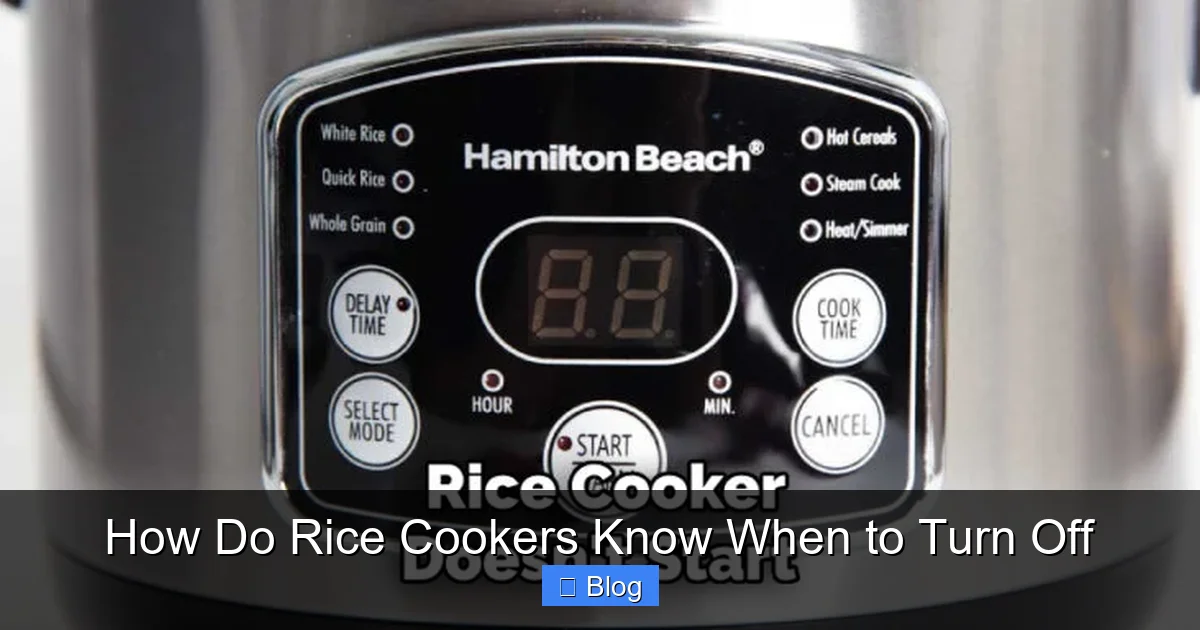
Rice cookers know when to turn off primarily through a thermal sensor that detects temperature changes as water boils away. Basic models use a bimetallic strip or thermistor that triggers a mechanical or electrical switch when the cooking pot reaches a specific temperature (usually around 100°C/212°F at sea level). More advanced “fuzzy logic” cookers use microprocessors and multiple sensors to adjust cooking time and temperature for different grains, ensuring perfect results. This automatic shut-off is a critical safety and convenience feature, preventing burnt rice and potential hazards.
Have you ever dumped a cup of rice and water into your cooker, pushed a button, and walked away, only to return to perfectly fluffy, unburnt rice? It feels like magic. But it’s not magic—it’s brilliant, elegant engineering. The moment your rice cooker clicks from “Cook” to “Keep Warm” is one of the most reliable conveniences in the modern kitchen. Yet, most of us never stop to wonder: how do rice cookers know when to turn off? The answer is a fascinating journey through basic physics, smart sensors, and clever automation. Let’s pull back the curtain and explore the science that saves you from stirring and watching a pot.
At its heart, a rice cooker is a simple device with a singular, life-changing mission: to apply heat to a pot containing rice and water until the water is gone, then stop. The challenge is that it must do this without you having to guess when the water has evaporated. It needs to “sense” the transition from a wet, boiling environment to a dry, hot one. This is where the thermal sensor comes in—the unsung hero of every countertop appliance. Whether you have a $20 basic model or a $300 fuzzy logic masterpiece, they all rely on the same fundamental principle: detecting a specific temperature change. The difference lies in how sophisticated that detection and response system is.
Key Takeaways
- Core Mechanism: The shut-off is triggered by a thermal sensor (bimetallic strip or thermistor) that responds to the pot’s temperature rise after all water has evaporated.
- Critical Temperature: The sensor is calibrated to activate near the boiling point of water (100°C/212°F), signaling the end of the steaming phase.
- Thermostat Types: Basic cookers use a mechanical thermostat (physical switch), while digital models use an electronic circuit controlled by a microprocessor.
- Fuzzy Logic Advantage: High-end cookers use algorithms and multiple inputs to make nuanced adjustments, perfect for different rice types and altitudes.
- Safety Redundancy: Modern cookers include backup safety features like thermal fuses and pressure release valves to prevent overheating or pressure buildup.
- Maintenance is Key: Sensor accuracy depends on cleanliness; mineral deposits on the heating plate or sensor can cause failure to shut off or undercooking.
- Not Just for Rice: The same principle allows cookers to steam vegetables, cook soups, and make porridge by using different temperature thresholds.
📑 Table of Contents
- The Basic Principle: Water, Heat, and a Critical Temperature Shift
- The Thermal Sensor: The Cooker’s “Thermometer”
- The Thermostat: From Snap-Disc to Microprocessor
- Fuzzy Logic: The Smart Cooker’s Brain
- Safety Features: More Than Just an Off Switch
- Troubleshooting and Maintenance: Why Your Cooker Might Not Turn Off
- Conclusion: The Humble Triumph of Automated Cooking
The Basic Principle: Water, Heat, and a Critical Temperature Shift
To understand the shut-off mechanism, you first need to understand what’s physically happening inside the pot. You start with a mixture of rice and cold water. As the heating element warms the pot, the water temperature rises. It hits 100°C (212°F at sea level) and begins to boil vigorously. This boiling phase is crucial. The rice cooks by absorbing this hot, steaming water. The cooker’s job is to maintain a rolling boil until—and this is the key—until all the added water has been absorbed by the rice and evaporated into steam.
Once the last vestige of free water is gone, something dramatic happens. The pot, now in direct contact with the heating element and containing only moist rice, rapidly heats up above the boiling point of water. It might jump to 110°C, 120°C, or even higher, depending on the model and the grain. This sharp temperature increase is the signal. The cooker’s brain (be it a simple bimetal strip or a microchip) is waiting for this exact signal. It’s the universal sign that the cooking phase is complete and the rice is done. If the cooker didn’t turn off at this point, the dry rice would quickly scorch, producing smoke and potentially ruining the appliance. So, the entire automatic cycle hinges on accurately detecting that temperature spike from ~100°C to ~110°C+.
The Role of Water Absorption and Boiling Point
Different grains absorb water at different rates and volumes. White rice, with its polished surface, absorbs water relatively quickly. Brown rice, with its intact bran layer, takes much longer and often requires more initial water. A basic rice cooker is calibrated for a standard ratio of white rice to water. It assumes a fixed cooking time based on that ratio and the typical boiling point. If you use it for brown rice without adjusting the water, the basic timer might shut off before the rice is fully cooked because the water is absorbed slower, and the temperature might not spike as quickly or as high. This is where more advanced models with fuzzy logic come into play, but we’ll get to that. For now, know that the fundamental trigger is the absence of liquid water causing a temperature rise.
The Thermal Sensor: The Cooker’s “Thermometer”
The component responsible for feeling this temperature change is the thermal sensor. It’s usually a small metal disc or probe mounted in direct contact with the bottom of the inner cooking pot or the heating plate itself. There are two primary types found in consumer rice cookers:

Visual guide about How Do Rice Cookers Know When to Turn Off
Image source: thekitchenix.com
- Bimetallic Strip (Mechanical): This is the old-school, reliable workhorse. It’s made of two different metals bonded together that expand at different rates when heated. As the temperature rises, the strip bends or curls. This mechanical movement is directly linked to a lever that physically flips a switch, cutting power to the heating element. You can often hear a distinct click when this happens. It’s a purely mechanical, fail-safe system with no electronics required.
- Thermistor (Electronic): A thermistor is a special type of resistor whose electrical resistance changes significantly with temperature. In a digital rice cooker, the thermistor feeds a continuous stream of resistance data to the control board. The microchip constantly monitors this data. When it sees the resistance value corresponding to the target “done” temperature, it sends a signal to a relay or solid-state switch to turn off the heater. This allows for much more precise temperature control and is the foundation for fuzzy logic programming.
Placement and Calibration Are Everything
The sensor’s location is critical. It must be in perfect thermal contact with the part of the pot that best represents the overall cooking medium temperature. In most designs, it’s pressed against the bottom center of the pot or embedded in the heating plate. If the sensor is dirty, coated in mineral scale from hard water, or not seated correctly, it becomes an unreliable reporter. It might think the pot is still at 100°C when it’s actually hotter (leading to burnt rice) or might not detect the boiling phase properly (leading to undercooked, soggy rice). This is why cleaning the heating plate and the pot’s exterior, especially the bottom, is a vital part of rice cooker maintenance.
The Thermostat: From Snap-Disc to Microprocessor
The sensor tells the story, but the thermostat is the decision-maker that acts on that information. The evolution of the thermostat mirrors the evolution of the rice cooker itself.
Visual guide about How Do Rice Cookers Know When to Turn Off
Image source: thekitchenix.com
1. Mechanical Snap-Disc Thermostat
In the simplest cookers, the bimetallic strip is the thermostat. The bending metal physically snaps a switch. It’s a one-trick pony: it’s either ON (heating) or OFF (not heating). There is no “keep warm” phase controlled by this mechanism; a second, lower-temperature thermostat or a simple power resistor usually handles the warming function. This system is incredibly robust, cheap to manufacture, and has a satisfying audible click. Its limitation is inflexibility. It’s calibrated for one specific temperature threshold and one type of rice (usually standard white rice). Cook a different grain, live at a high altitude where water boils at 95°C, or use slightly more water, and the results can be inconsistent.
2. Electronic Thermostat with Microcontroller
In digital rice cookers, the thermistor feeds data to a small computer—the microcontroller. This chip runs a simple program. It has a pre-set target temperature stored in its memory (e.g., 105°C). It monitors the sensor input. When the temperature crosses that threshold and stays there for a set number of seconds (to avoid false triggers from brief spikes), the chip de-energizes a relay, cutting power to the heating element. It then might activate a separate, lower-power heating circuit for the “Keep Warm” mode, which maintains a temperature just below the scalding point (typically 65-75°C). This electronic system allows for more precise temperature holding and the addition of timer functions, but it still operates on a single, fixed threshold for the cooking phase.
Fuzzy Logic: The Smart Cooker’s Brain
This is where things get sophisticated. Brands like Zojirushi and Panasonic popularized “fuzzy logic” in rice cookers in the 1980s and 90s. It’s not artificial intelligence, but it’s a form of computational logic designed to handle imprecise, real-world variables—just like cooking rice.

Visual guide about How Do Rice Cookers Know When to Turn Off
Image source: thekitchenix.com
How Fuzzy Logic Works in a Rice Cooker
A fuzzy logic rice cooker has a more advanced microcontroller and often multiple sensors (for pot temperature, ambient temperature, and sometimes even pressure). Instead of a single, hard-coded “turn off at 105°C” rule, it uses a set of “if-then” rules that account for nuances. For example:
- IF the temperature rises quickly to 100°C and stays steady for 5 minutes, THEN assume standard white rice, calculate cooking time based on initial water volume, and shut off after ~18 minutes.
- IF the temperature rise to 100°C is slow and gradual, THEN assume a harder grain like brown rice or a larger volume, and extend the cooking time by 10-15 minutes before checking for the final temperature spike.
- IF the final temperature spike only reaches 108°C instead of 115°C, THEN infer that the cook may have been at a high altitude and adjust the keep-warm temperature slightly.
It essentially makes continuous, micro-adjustments during the cooking cycle based on the thermal profile. The result is consistently better texture and taste across a wide variety of rices (sushi, jasmine, basmati, brown, wild, even oatmeal), and it compensates better for minor variations in water measurement or ambient conditions. The shut-off decision is no longer a single event based on one number, but the culmination of a analyzed cooking curve.
Practical Example: Cooking Brown Rice
On a basic cooker, you might need to use the “brown rice” setting, which is often just a longer, fixed timer. The cooker will run for, say, 45 minutes and then shut off, regardless of whether the water is fully absorbed. You might get mushier or undercooked results. On a fuzzy logic cooker, you select “Brown Rice.” The cooker begins heating. It notes how long it takes to reach a steady boil. It monitors how the temperature behaves during the long absorption phase. Only when it detects the definitive dry-heat temperature spike does it initiate the final “steam rest” phase and then shut off. It’s adapting to the grain’s actual needs in real-time.
Safety Features: More Than Just an Off Switch
The automatic shut-off is the primary safety feature, but modern cookers are built with layers of redundancy to prevent catastrophic failure if the main sensor or thermostat malfunctions.
Thermal Fuse (One-Time Use)
This is a simple, non-resettable safety device. It’s a small metal strip or pellet designed to melt at a temperature significantly higher than the normal operating max (e.g., 160°C). If the main thermostat fails and the heater runs unchecked, the pot and contents will eventually get dangerously hot. The thermal fuse will melt, physically breaking the circuit and cutting all power. This sacrifices the cooker (the fuse must be replaced) but prevents a fire or severe damage. It’s the last line of defense.
Pressure Release Valves (In Pressure Rice Cookers)
Some high-end cookers (and all pressure cookers) operate under pressure to raise the boiling point of water, cooking food faster. These have a weighted pressure release valve and often a secondary, safety plug that melts at an even higher pressure to prevent explosion. The shut-off mechanism in these models is tied to both temperature and pressure sensors. The cooker knows to reduce pressure and temperature when the cooking cycle is complete.
Overheat Protection Circuits
In digital models, the microcontroller constantly monitors for abnormal sensor readings. If the sensor reports a temperature that exceeds the maximum safe operating limit (even if it’s not the normal “done” spike), the software can force an immediate shutdown and lockout, requiring a full reset. This protects against sensor failure or a short circuit.
Troubleshooting and Maintenance: Why Your Cooker Might Not Turn Off
Understanding the mechanism helps diagnose problems. If your cooker isn’t turning off automatically, here are the most common culprits, ranked from most to least likely:
1. A Dirty or Faulty Sensor
This is the #1 cause. Mineral deposits from hard water can coat the sensor or the heating plate, creating an insulating layer. The sensor can no longer accurately “feel” the pot’s temperature. It might report a lower temperature than reality, so the cooker never gets the signal to shut off. Solution: Unplug the cooker. Clean the heating plate with a vinegar-water solution and a non-abrasive pad. Wipe the bottom of the inner pot clean. Ensure the sensor contact area is spotless.
2. A Failed Thermostat or Thermistor
The component itself has burned out. A bimetal strip may have lost its elasticity. A thermistor may have developed an open circuit. Solution: This requires diagnosis with a multimeter and likely replacement. For inexpensive basic models, replacement may not be cost-effective. For higher-end models, contact the manufacturer or an appliance repair shop.
3. Incorrect Water-to-Rice Ratio
Using too much water means the pot may never get hot enough to trigger the shut-off before the rice becomes porridge. Using too little water can cause the rice to cook too quickly and the temperature to spike prematurely, potentially before the rice is fully hydrated (though it will still shut off). Solution: Always use the measuring cup that came with the cooker and follow the recommended water lines inside the pot. These ratios are calibrated for that specific appliance’s sensor and heating power.
4. Cooking Non-Rice Items Without Adjustment
You can’t cook a large pot of soup or stew on the “white rice” setting and expect a perfect shut-off. The cooker is programmed for a specific thermal profile. Solution: Use the appropriate setting (if available) or treat the cooker as a simple boiling pot and manually intervene.
5. High Altitude
Water boils at a lower temperature at higher elevations. A cooker calibrated for 100°C might see the pot reach 95°C and think it’s still boiling, delaying the final temperature spike. Solution: Some advanced models have altitude adjustment. For basic models, you may need to add a tablespoon or two of extra water and accept that the cooking cycle might run a bit longer.
Maintenance Tip: The Monthly Deep Clean
To keep your sensor accurate, perform this monthly if you have hard water: Fill the pot with a 1:1 solution of white vinegar and water to the “3-cup” line. Let it sit for 30 minutes. Then, run a full cooking cycle with just the vinegar-water (no rice). Discard the liquid, rinse the pot thoroughly, and run another cycle with clean water. This dissolves mineral deposits on the heating plate and sensor.
Conclusion: The Humble Triumph of Automated Cooking
The next time your rice cooker dings, take a second to appreciate the quiet symphony of physics and engineering that just occurred. A thermal sensor felt the heat. A thermostat made a decision. In smarter models, a microchip analyzed a complex profile. And all of it happened safely and reliably, freeing you to focus on the main course, the conversation, or simply relaxing. This automatic shut-off is the cornerstone of the appliance’s value proposition: consistent results without vigilance. It’s a technology so successful it’s invisible, taken for granted in millions of kitchens worldwide. From the satisfying click of a bimetal strip to the silent logic of a fuzzy logic chip, the goal is the same: perfect rice, zero guesswork. As technology advances, we might see even more integration with smart home systems or cameras that visually detect doneness, but the fundamental principle—detecting the end of liquid water through temperature—will likely remain the beating heart of the rice cooker for decades to come. It’s a perfect blend of simple science and brilliant design, turning a daily chore into a background task.
Frequently Asked Questions
Can I use my rice cooker for other grains like quinoa or barley?
Yes, most rice cookers can handle other grains. Use the appropriate water ratio for that grain and select the “white rice” or “mixed” setting if available. The cooker will still shut off based on temperature, but the texture may vary from a dedicated setting. For heartier grains, a fuzzy logic model will yield better results.
What should I do if my rice cooker won’t turn off automatically?
First, unplug it immediately as a safety precaution. The most common cause is a dirty sensor or heating plate. Clean both thoroughly with a vinegar solution. If the problem persists, the thermostat or thermistor may be faulty and require professional repair or replacement.
Do rice cookers work the same at high altitudes?
Not perfectly. Water boils at a lower temperature at high altitudes, which can delay the temperature spike that triggers shut-off. You may need to use slightly more water and expect a longer cooking cycle. Some advanced models have an altitude adjustment setting to compensate.
Is the “Keep Warm” function controlled by the same sensor?
Usually not. The “Keep Warm” function is typically controlled by a separate, lower-temperature thermostat or a different setting on the main thermostat. It maintains a safe serving temperature (65-75°C) without continuing to cook the rice, which would dry it out.
How often should I clean the heating plate and sensor?
If you use the cooker daily and have hard water, clean the heating plate and pot bottom monthly with a vinegar-water solution to prevent mineral buildup. For soft water users, a quarterly deep clean is usually sufficient. Always ensure the pot is completely dry before storing.
What’s the difference between a thermistor and a bimetallic strip?
A bimetallic strip is a mechanical device that physically bends with heat to flip a switch. It’s found in basic, inexpensive models and produces an audible click. A thermistor is an electronic component whose electrical resistance changes with temperature; it sends data to a microchip in digital cookers, allowing for more precise and programmable control, including fuzzy logic.
Pingback: Zojirushi Rice Cooker - kitchenandhouseware.com