Identifying real Damascus steel requires looking beyond the beautiful pattern. A genuine knife features a visible, consistent layered structure when etched or on the bevel, not just a surface design. It will pass a magnetic test (low magnetism) and an acid test (pattern persists after light etching). Fake Damascus is often just etched or laser-engraved on a single piece of steel, with no true lamination. Always buy from reputable, transparent makers who detail their process.
You’re drawn to the mesmerizing, watery patterns of a Damascus knife. That swirling, almost organic design promises history, craftsmanship, and superior performance. But here’s the uncomfortable truth: the market is flooded with fakes. That beautiful pattern might just be a shallow etching on a cheap, single-piece blade. So, how do you separate the authentic, forged-in-fire masterpieces from the pretty impostors? Telling if a knife is real Damascus isn’t about a single trick; it’s about understanding what Damascus steel truly is and performing a series of observational and practical checks.
This guide will walk you through everything you need to know. We’ll move from simple visual cues you can spot with your eyes to more involved tests you can try at home (safely!). By the end, you’ll have the knowledge to confidently evaluate any knife claiming to be Damascus, ensuring your investment is in genuine, layered steel history, not just a clever paint job.
Key Takeaways
- Real Damascus is Pattern-Welded: It’s made by forge-welding layers of different steels, creating a pattern that is part of the metal’s structure, not applied to the surface.
- The Acid Etch is the Gold Standard Test: A genuine pattern will deepen and become more defined when lightly etched with ferric chloride, revealing the layered grain. A fake’s surface engraving will be removed or unaffected.
- Check the Bevel and Edge: The pattern should be visible on the knife’s bevel (the angled ground section leading to the edge) and even on the very edge itself after sharpening, proving it runs through the entire steel.
- Low Magnetic Response: Due to the specific steels and heat treatment used, genuine Damascus often shows only slight attraction to a magnet compared to a solid piece of high-carbon steel.
- Pattern Consistency and Depth: Authentic patterns have a 3D, watery, or organic look with visible depth. Fakes often look flat, overly uniform, or like a sticker. Look for pattern variations along the blade.
- Construction Clues: The tang (the part of the blade inside the handle) should show the layered pattern. The spine (back of the blade) may also show a subtle pattern if the maker exposed the layers.
- Price and Provenance Matter: Authentic, hand-forged Damascus is labor-intensive and expensive ($500+ for a good chef’s knife). If the price seems too good to be true for a “Damascus” blade, it almost certainly is.
📑 Table of Contents
- What is “Real” Damascus Steel? A Critical Definition
- The Visual Pattern Test: What to Look For With Your Eyes
- The Acid Etch Test: The Definitive Chemical Proof
- The Magnetic Test: A Quick, Subtle Clue
- Construction and Material: The Maker’s Story
- Common Damascus Scams and How to Spot Them
- Conclusion: Trust, But Verify
What is “Real” Damascus Steel? A Critical Definition
First, we must define our terms, because confusion starts here. The term “Damascus” is used in two very different ways, and only one is historically and metallurgically accurate for modern knives.
The Historical Misnomer: Wootz Steel
When people think of ancient Damascus blades, they picture swords from the medieval Islamic world with distinctive flowing patterns. These were made from a unique Indian steel called wootz. Wootz was a crucible steel—a high-carbon steel with trace carbide-forming elements, cast into ingots. When forged and heat-treated correctly, it developed a natural, patterned microstructure. However, the exact process was lost centuries ago. No one today is making true historical wootz Damascus in any commercial quantity.
The Modern Reality: Pattern-Welded Damascus
This is what “real Damascus” means for modern knives and tools. It’s a recreation technique that emerged in the 1970s. A blacksmith takes two or more different types of steel (often a high-carbon, hard steel and a milder, more ductile steel like nickel-steel). They are stacked, bound, and heated in a forge until white-hot. Then, through a process of repeated heating, folding, and hammering (forge-welding), the layers are compressed and fused into a single, solid billet with hundreds or thousands of layers.
The magic happens during the acid etching process. The different steels etch at slightly different rates when submerged in an acid solution (usually ferric chloride). The softer, nickel-rich layers etch back, while the harder, high-carbon layers remain proud, revealing the stunning, rippled pattern. The pattern is an inherent part of the metal’s cross-section, not a surface decoration. This is the crucial distinction. If the pattern is only on the surface and disappears if you grind it off, it’s fake.
The Visual Pattern Test: What to Look For With Your Eyes
Before you pick up any tools, a meticulous visual inspection is your first and most important line of defense. You’re looking for the hallmarks of a true layered structure.

Visual guide about How to Tell If a Knife Is Real Damascus
Image source: knifeade.com
Look for Depth and a “3D” Watery Effect
Run your fingers lightly across the pattern (be gentle!). On a genuine pattern-welded blade, you should feel a very slight, almost imperceptible texture—a tiny ridge where the harder steel protrudes. The pattern should look like it’s in the metal, not on it. It has a depth, a watery, organic quality. Fake patterns, often applied via acid etching on a solid bar (where a single steel is selectively etched), or laser etching/engraving, will look flat, like ink on paper. They lack that subtle dimensionality.
Examine the Bevel and The Edge
This is the single most telling area. The bevel is the ground, angled section of the blade that forms the cutting edge. On a real Damascus knife, the pattern must continue seamlessly from the flat of the blade onto the bevel and all the way to the very edge.
Why? Because the pattern runs through the entire thickness of the steel. When the bevel is ground, it’s simply revealing a cross-section of the layered billet. If you look closely at a well-made genuine knife, you’ll see the pattern get finer and tighter as it approaches the edge, because you’re looking at a thinner and thinner slice of the layered stack.
Fake Alert: If the pattern stops abruptly at the start of the bevel, or if the bevel is a completely smooth, pattern-free expanse of steel, you have a fake. The pattern is likely a surface treatment on the flat only. Some low-end fakes will even have a sticker-like decal that peels at the edge.
Inspect the Spine and Tang
Look at the spine (the unground back of the blade). Does it show a subtle, ghostly pattern? A skilled maker will often leave a small portion of the spine or the ricasso (the flat section at the base of the blade) unpolished to showcase the billet’s structure. Even if polished, a faint pattern may be visible under good light.
Even more telling: if you can, look at the tang—the part of the blade that extends into the handle. If the handle is removed or you can see inside the scales, the tang should display the layered pattern. This is proof positive the pattern runs through the entire bar of steel, not just one face.
Pattern Consistency and “Story”
Authentic patterns have a natural, organic variation. They might shift from a tight “ladder” pattern to a watery “random” pattern along the blade’s length, reflecting how the billet was manipulated during forging. No two sections will be perfectly identical, like tree rings or marble.
Fake patterns, especially laser-etched ones, are often repetitive and machine-perfect. The same motif will copy-and-paste down the blade. Also, look for pattern “bleeding”—where a line seems to fade out unnaturally. This can happen with surface etching but is less common in true depth etching.
The Acid Etch Test: The Definitive Chemical Proof
This is the most reliable test you can perform. It directly challenges the fundamental principle of Damascus: that the pattern is a result of different etch rates between layers.
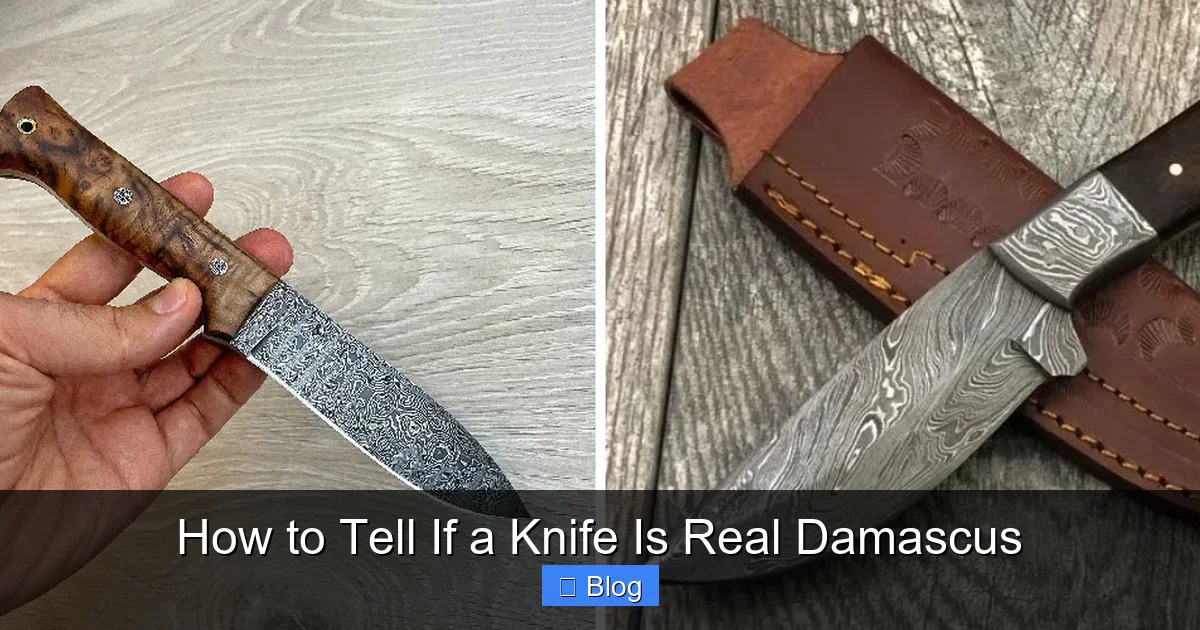
Visual guide about How to Tell If a Knife Is Real Damascus
Image source: metalfixes.com
How the Test Works
You need a small, inconspicuous area. Ferric chloride (FeCl3), available as PCB etchant from electronics stores, is the standard. Safety first: Wear gloves and eye protection. Work in a well-ventilated area. Dilute it with water (a 1:1 or 1:2 ratio of etchant to water is a good start). Using a cotton swab or small brush, apply the solution to a small, hidden spot on the blade—the underside near the tang or an area inside the handle if possible. Let it sit for 30-60 seconds, then rinse thoroughly with water and neutralize with a baking soda solution. Dry immediately.
Interpreting the Results
- Real Damascus: The pattern will deepen and become more pronounced. The contrast between the dark, etched-back layers and the bright, raised layers will increase dramatically. You’ve essentially accelerated the natural etching process. The pattern you see is the true, structural layer boundary.
- Fake Damascus (Surface Etched): The shallow, surface-level pattern will likely wash away or become significantly blurred. You’ve removed the thin layer of metal that was differentially etched to create the design. What remains might be a faint, uniform gray from the acid attacking the single steel type.
- Fake Damascus (Laser/Engraved): The pattern will be completely unaffected. The laser lines are just a surface scar; the acid doesn’t change their appearance. The surrounding metal may darken uniformly, but the crisp lines of the fake pattern will remain starkly visible, proving they are not a result of layered steel.
Pro Tip: A professional maker will often have their blades already deeply etched. In this case, the visual test becomes even more critical. You’re looking for that 3D depth in the existing etch.
The Magnetic Test: A Quick, Subtle Clue
This is a simple, non-destructive test that can provide supporting evidence. It relies on the magnetic properties of the steels typically used in modern pattern-welding.
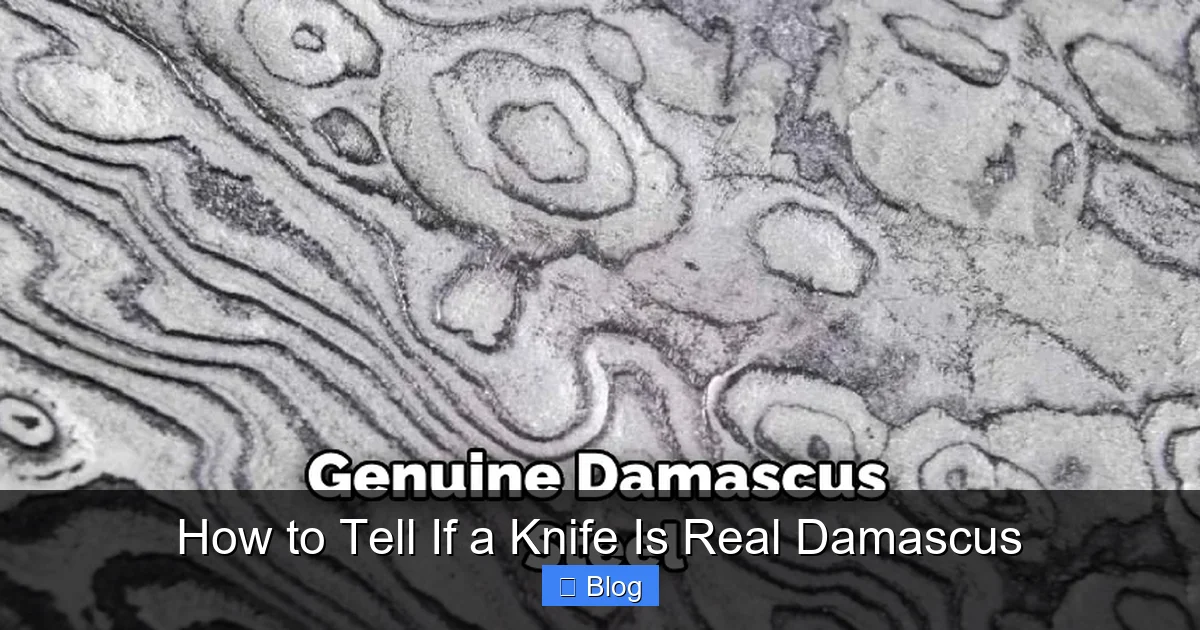
Visual guide about How to Tell If a Knife Is Real Damascus
Image source: metalfixes.com
The Science Behind It
The most common combination is a high-carbon steel (like 1095, 15N20) and a nickel-bearing steel (like 15N20, 41L15). The nickel steel is austenitic and is non-magnetic or very weakly magnetic after proper heat treatment. The high-carbon steel is martensitic and is strongly magnetic. In a well-made billet, these layers are thin and intertwined.
When you bring a strong magnet (a neodymium magnet is best) close to a real Damascus blade, the magnetic force will be noticeably weaker and more “grabby” or uneven than on a solid piece of high-carbon steel. The magnet might feel like it’s sticking to specific spots (the magnetic steel layers) but not others (the nickel layers). The overall pull is less because the non-magnetic layers interrupt the magnetic field.
Limitations and How to Test
Take a small, powerful magnet. Place it on the flat of the blade and note the strength of the hold. Then, try to slide it along the blade. On real Damascus, you’ll often feel it “catching” and releasing as it passes over the alternating magnetic/non-magnetic layers. On a solid piece of steel, it will glide smoothly with consistent, strong attraction.
Important Caveats: This is not a standalone proof. Some fake Damascus blades are made from a single piece of magnetic, etched steel and will fail this test (showing strong, uniform magnetism), which is a red flag. However, some authentic patterns using only magnetic steels (like two different high-carbon steels) will also show strong magnetism. Use this test as a supporting clue in conjunction with the visual and etch tests.
Construction and Material: The Maker’s Story
Authenticity is often revealed in the details of construction and the transparency of the maker. A reputable blacksmith or company is proud of their process and will share it.
Tang and Handle Construction
As mentioned, the tang should show the pattern. Also, examine the bolster (the thick piece between blade and handle, if present). On a full tang knife, the handle scales are pinned or riveted to the exposed tang. The sides of the tang, visible between the scales, should display the layered pattern. If the bolster is a separate, welded-on piece, the pattern might not continue through it, which is acceptable but should be disclosed.
Full Tang vs. Hidden Tang
Most high-end Damascus knives are full tang, meaning the steel extends the full length and width of the handle. This is a mark of strength and allows the pattern to be visible on the tang. A hidden tang (where a narrow rod is inserted into the handle) is less common for Damascus, as it wastes the beautiful patterned material and is typically a cost-saving measure on lower-end or decorative knives. If a “Damascus” knife has a hidden tang, be extra skeptical.
Steel Types and Performance Claims
Ask or research: what steels are used? Authentic makers will proudly state their combination (e.g., “1095 & 15N20,” “15N20 & 41L15”). These are specific, known alloys. Vague claims like “high-carbon Damascus steel” are meaningless. Also, beware of outlandish performance claims. While pattern-welded steel can be very good, it is not inherently “superior” to a well-made, single-piece modern powder metallurgy steel like CPM-S30V. Its value is in aesthetics and tradition, not necessarily in ultimate edge retention or toughness over the best mono-steels. If a seller claims their cheap Damascus is “better than S30V,” they are lying.
Common Damascus Scams and How to Spot Them
Now let’s dissect the fakes. Understanding the common manufacturing tricks is key to spotting them.
1. Surface Etching on Solid Steel
This is the most common scam. A blade is made from a single piece of steel (often cheap stainless or low-carbon steel). The pattern is created by selective acid etching (using a resist like wax or tape) or by laser etching/engraving. The pattern is purely a surface treatment.
How to Spot It: The bevel is pattern-free. The pattern looks flat and sticker-like. The acid etch test will remove or not affect the pattern. The magnetic test will show uniform, strong magnetism.
2. “Damascus” Stainless Steel
True pattern-welded Damascus is almost always made from high-carbon steels that can be forge-welded and take a deep, high-contrast etch. Most stainless steels cannot be forge-welded in a traditional smithy due to their chromium content forming a passive oxide layer. You cannot make true layered Damascus from common stainless steels (like 440C).
If a knife is labeled “Stainless Damascus” and is inexpensive, it is 99.9% a fake. The pattern is surface-applied on a stainless blade. True stainless pattern-welded steel exists (using specialized welding techniques or specific alloys like 416), but it is extremely rare, expensive, and will be clearly marketed as such by top-tier makers.
3. The “Pattern-Doped” Blade
Some fakes involve a thin layer of pattern-welded steel being forge-welded or diffusion-bonded onto a solid core of cheaper steel. This is a more advanced scam. The pattern will be visible on the flat, but if you look extremely closely at the bevel or edge, you might see the pattern fade or disappear as the thin patterned layer is ground away, revealing the solid core underneath. This is rare but exists in some mid-tier manufactured knives.
4. The “Too-Perfect” Pattern
If the pattern is a perfect, repeating motif like identical flowers, stars, or a perfectly straight “ladder” pattern with no variation, it is almost certainly machine-made (laser or CNC engraved) on a single bar. Nature and the forge produce variation. Perfection is a sign of a machine.
Conclusion: Trust, But Verify
Identifying real Damascus steel is a skill built on knowledge and observation. Remember the core principle: real Damascus is a layered composite, and its pattern is a cross-section of that lamination. Your investigation should follow this hierarchy:
- Bevel & Edge: Is the pattern on the bevel and edge? If no, it’s fake.
- Acid Etch Test: Does a light etch deepen the pattern? If it removes or ignores it, it’s a surface treatment.
- Visual Depth: Does it look 3D and organic, or flat and printed?
- Construction: Does the tang show the pattern? Is it full tang? What steels are claimed?
- Price & Source: Is the price realistic for hand-forged, multi-layer steel ($500+ for a chef’s knife)? Is the maker reputable and transparent?
There is no single, effortless test. The fakers are good. But by combining these methods—especially the critical bevel check and the revealing acid etch—you can see through the marketing hype. You’re not just buying a pretty knife; you’re investing in a artifact of metallurgical craft. That deserves verification. When in doubt, ask the seller for specific steel types, layer count, and whether they can provide a photo of the tang or bevel. A honest maker will have nothing to hide. Your sharp eye is the final quality control.
Frequently Asked Questions
Can I use the magnet test as the only way to identify Damascus?
No. The magnet test is only a supporting clue. Some authentic Damascus made from two magnetic steels will be strongly magnetic, while some fakes made from a single magnetic steel will also be magnetic. It cannot be used alone to confirm or deny authenticity.
If a knife has a beautiful Damascus pattern, does it matter if it’s “real”?
It depends on your purpose. If you value the history, craftsmanship, and unique story of true pattern-welded steel, then yes. If you only want a visually striking blade for display and the price reflects a decorative piece, it’s a personal choice. However, fakes are often sold at a premium pretending to be something they’re not, which is deceptive.
Will the pattern on real Damascus fade or disappear over time with use and sharpening?
The pattern will not disappear, but it will evolve. Every time you sharpen the knife, you are removing a microscopic layer of steel and revealing a fresh cross-section of the billet. The pattern may become slightly less pronounced on the bevel over decades of sharpening, but the layered structure remains throughout the entire blade. It will never “wear off” like a surface treatment.
Is “Damascus” a type of steel or a process?
It is a process, not a steel. “Damascus” refers to the technique of pattern-welding and etching. The resulting pattern is a product of the process and the different steels used. There is no single “Damascus steel” alloy. The steels used underneath (like 1095, 15N20) are the actual materials.
Is pattern-welded Damascus steel better than modern mono-steels like S30V or Magnacut?
Not inherently. For pure, measurable performance metrics like edge retention, corrosion resistance, and toughness, advanced powder-metallurgy mono-steels are generally superior. The value of real Damascus is in its aesthetics, tradition, and the artisan’s skill. It is a functional art form. A good pattern-welded blade can be exceptionally tough and hold a great edge, but it is not a performance miracle material.
Where is the safest place to buy a real Damascus knife?
The safest places are directly from renowned custom knife makers or established, high-end cutlery companies known for their forged lines (e.g., some models from brands like Shun, certain custom makers in the American Bladesmith Society). These sources are transparent about their materials, processes, and stand behind their work. Avoid large online marketplaces, auction sites with vague descriptions, and any seller who cannot answer specific questions about steel types and construction.