No, food processors and blenders are not the same. While both are electric kitchen appliances with blades, they are engineered for fundamentally different tasks. A blender excels at liquefying, pureeing, and emulsifying ingredients with liquid, using a high-speed vortex. A food processor is designed for dry or semi-solid ingredients, performing precise, controlled tasks like chopping, shredding, slicing, and kneading dough with specialized attachments. Using the wrong tool for the job leads to poor results and frustration. Understanding their distinct mechanics and optimal uses is crucial for efficient cooking and baking.
Key Takeaways
- Core Function Differs: Blenders create liquids/smoothies via a vortex; food processors handle solids with precision chopping/shredding.
- Blade Design is Specialized: Blenders have a fixed, single blade; food processors use interchangeable discs and blades for specific tasks.
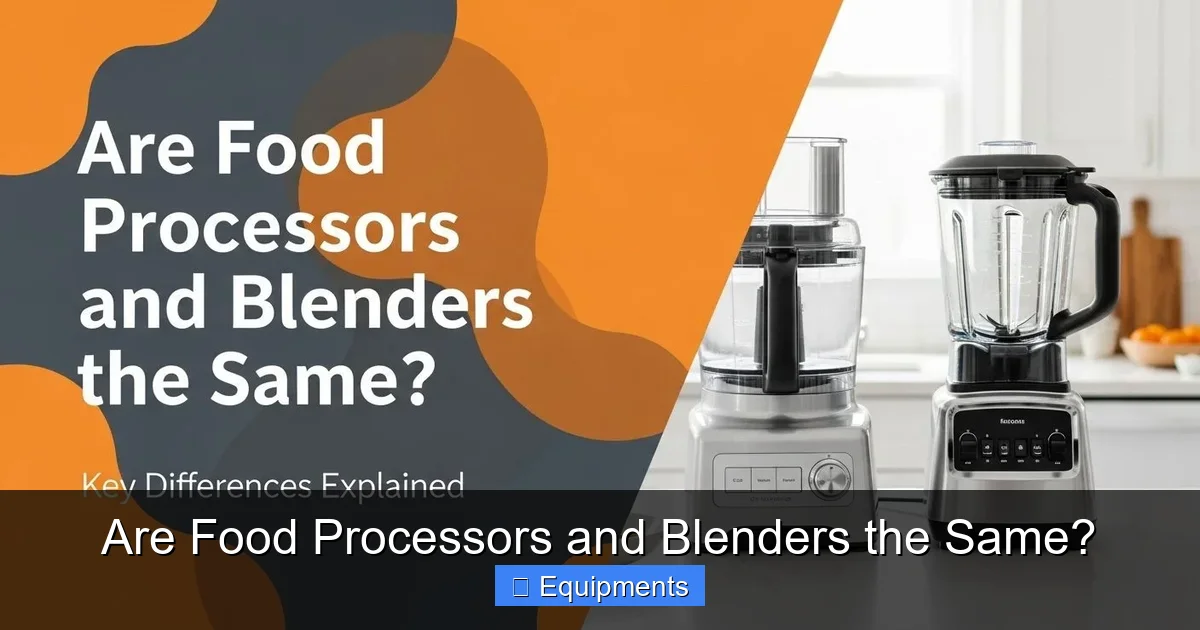
- Container Shape Matters: Blender jars are tall and narrow for vortex action; processor bowls are wide and shallow for even processing.
- Texture Outcomes are Opposite: Blenders make things drinkable; food processors make things particulate (chopped, grated, etc.).
- Power and Speed Profiles Vary: Blenders need sheer speed for ice/frozen items; processors need torque for dough and hard vegetables.
- They Are Complementary, Not Interchangeable: A serious cook benefits from owning both for maximum efficiency and recipe capability.
- Substitution Often Fails: Trying to make dough in a blender or a smoothie in a processor typically yields a messy, ineffective result.
📑 Table of Contents
- Introduction: The Great Kitchen Appliance Debate
- Understanding the Core Mechanics: How They Actually Work
- Blade and Attachment Architecture: Tools for the Job
- Texture and Functionality: Liquid vs. Solid Realms
- Ideal Uses: When to Reach for Which Tool
- Choosing the Right Tool for Your Kitchen: A Practical Guide
- Care, Maintenance, and Longevity
- Conclusion: The Final Verdict
Introduction: The Great Kitchen Appliance Debate
Walk into any modern kitchen, and you’ll likely find two countertop workhorses: a blender and a food processor. They both have motors, containers, and sharp blades. They both hum and whirl and can seemingly tackle similar ingredients. So, it’s a logical question: are food processors and blenders the same? The short, emphatic answer is no. They are specialized tools, as different as a chef’s knife and a carving fork. Understanding this difference isn’t just culinary trivia—it’s the key to unlocking efficiency, saving money on wasted ingredients, and dramatically improving your results in the kitchen.
This confusion is understandable. Marketing often blurs the lines, with some blenders boasting “food processor” attachments and some processors claiming “blender” capabilities. But at their core, their engineering philosophies diverge. One is built to pulverize and incorporate air and liquid into a homogeneous mixture. The other is built to cut, grate, and mix solid ingredients while keeping them distinct. Choosing the wrong one for a task like making hummus, pie dough, or a frozen margarita can mean the difference between a culinary triumph and a frustrating, chunky, or overheated mess. Let’s dive deep into the mechanics, functions, and ideal scenarios for each to permanently settle this debate.
Understanding the Core Mechanics: How They Actually Work
The fundamental difference between a blender and a food processor lies in the primary motion they create inside their respective containers. This motion dictates what they can do well.
Visual guide about Are Food Processors and Blenders the Same?
Image source: almardesigns.com
The Blender’s High-Speed Vortex
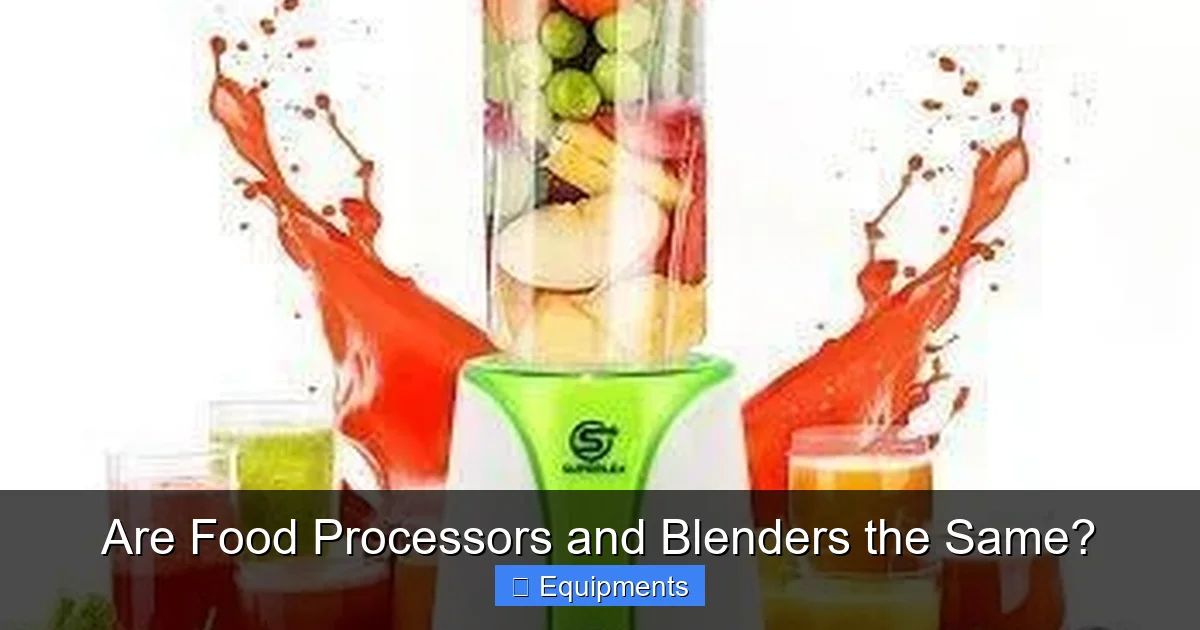
A blender’s entire design is engineered to create a powerful, downward-pulling vortex. The tall, narrow jar shape is crucial here. The angled blades, spinning at extremely high speeds (often 15,000 to 30,000+ RPM), pull ingredients from the top down to the bottom, forcing them into a cyclonic whirlpool. This action is perfect for incorporating air (think fluffy whipped cream), breaking down ice and frozen fruit, and ultimately liquefying solids into a smooth, pourable consistency. The sealed lid often includes a removable plug to add liquids or ingredients *while* blending, which is essential for this vortex-dependent process. Without enough liquid to facilitate the vortex, a blender will simply spin dry ingredients around the sides, achieving nothing.
The Food Processor’s Controlled Precision
A food processor, in stark contrast, operates on a principle of controlled, mechanical force. Its wide, shallow bowl allows ingredients to sit in a single layer, ensuring even contact with the work bowl’s bottom and sides. The motor, while perhaps not spinning as fast as a blender’s, delivers higher torque—raw twisting power—to drive through tough jobs like kneading stiff dough or shredding hard carrots. Instead of a vortex, it uses a “sweeping” action. An S-shaped blade chops by moving ingredients across the bowl, while discs (shredding, slicing, grating) press ingredients against a stationary blade on the disc’s surface. This is a process of cutting and agitating, not liquefying. The feed tube on the lid allows you to add ingredients safely while the machine is running, a feature designed for solid foods, not liquids.
Blade and Attachment Architecture: Tools for the Job
Look inside either machine, and the difference in tooling becomes immediately apparent. This is where the specialization is most visible.
Visual guide about Are Food Processors and Blenders the Same?
Image source: kitchenwaresets.com
Blender Blades: The Continuous Loop
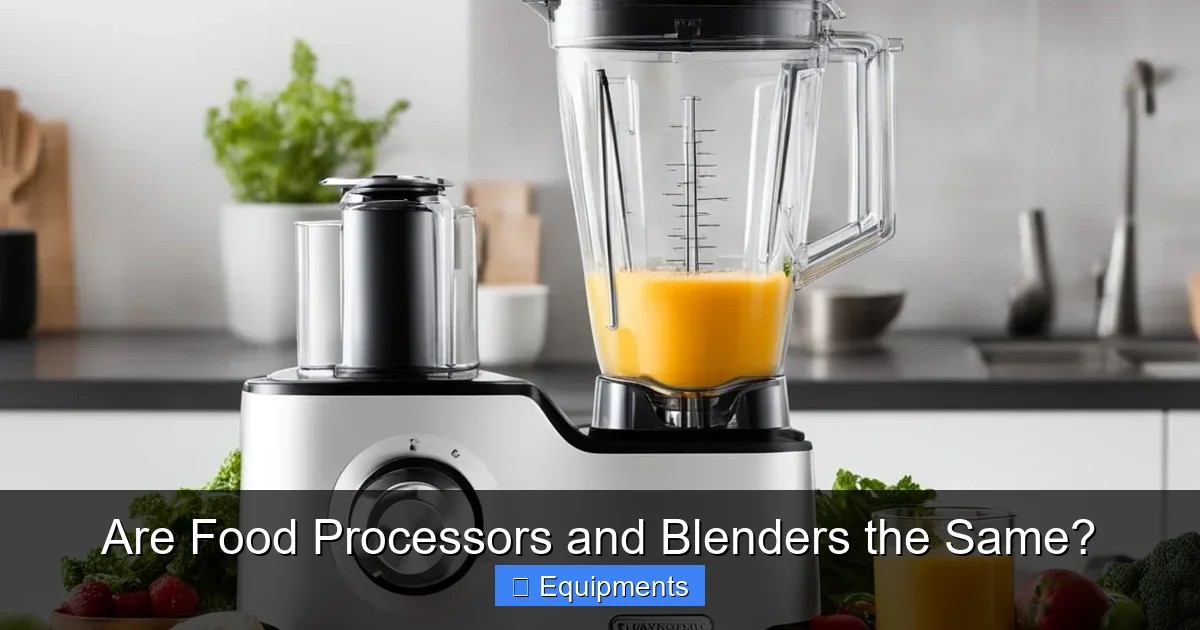
Blender blades are almost always a single, fixed piece—a cross-shaped or multi-pronged metal assembly permanently attached to the drive shaft. You cannot change it. Its job is singular: to create that powerful vortex and drag everything down to be struck repeatedly at high speed. Its effectiveness is entirely dependent on the presence of liquid to carry solids into the blade’s path. There are no alternative blades for slicing or shredding; the blender’s sole purpose is to reduce everything to a uniform, smooth texture.
Food Processor Discs and Blades: Task-Specific Tools
Open a food processor’s accessory box, and you’ll find a toolkit. The standard S-shaped “chopping” blade is for general mincing and pureeing (of thick things like nut butters or hummus). Then come the discs: a shredding disc (medium and large holes), a slicing disc (adjustable thickness on many models), a grating disc, and sometimes a julienne disc. For baking, you might find a dough blade (often plastic-coated to avoid over-developing gluten). Each attachment is engineered for a specific physical transformation—cutting, grating, or pressing—that a blender’s vortex simply cannot replicate. This modularity is the food processor’s greatest strength and clearest distinction.
Texture and Functionality: Liquid vs. Solid Realms
This is the practical outcome of the mechanical differences. The textures each appliance produces are mutually exclusive.
Visual guide about Are Food Processors and Blenders the Same?
Image source: kitchenwaresets.com
The Blender’s Domain: Emulsions and Purees
The blender is the undisputed king of liquids and semi-liquids. Its domain includes:
- Smoothies & Milkshakes: Breaking down ice, frozen fruit, and yogurt into a drinkable, uniform consistency.
- Soups & Sauces: Pureeing cooked vegetables directly in the pot (with an immersion blender) or creating silky smooth sauces like mayonnaise or hollandaise (with a countertop blender).
- Frozen Drinks: Crushing ice and frozen ingredients for margaritas, daiquiris, and frozen coffees.
- Nut Butters & Purees: Can make smooth nut butters or baby food purees, but only if you add sufficient oil and patience, as it relies on friction and heat.
The keyword is drinkable or spoonable smooth. Any recipe where the final product should flow like a liquid belongs to the blender.
The Food Processor’s Kingdom: Chopping, Shredding, Kneading
The food processor is the master of the solid or semi-solid state. Its kingdom includes:
- Chopping & Mincing: Onions, garlic, herbs, nuts, or meat without turning them into paste.
- Shredding & Grating: Cheese, carrots, zucchini, potatoes for hash browns or latkes.
- Slicing: Potatoes for scalloped potatoes, cucumbers for salads, apples for pies—all uniformly thin.
- Kneading Dough: Pizza, bread, and pie crust dough, developing gluten efficiently without over-warming the butter.
- Emulsifying *Thick* Sauces: Making pesto, hummus, or a thick Caesar dressing where the ingredients are mostly solids with just enough liquid to bind.
The keyword is particulate. You want to see and feel distinct pieces, shreds, or a cohesive but non-liquid mass. If the recipe involves a “pulse” function to control chop size, it’s a food processor task.
Ideal Uses: When to Reach for Which Tool
Let’s make this concrete with side-by-side comparisons of common kitchen tasks.
The Blender’s Signature Moves (Reach for This)
- Fruit & Vegetable Smoothies: Any recipe with ice or frozen fruit as a primary ingredient.
- Creamy Soups: Pureeing a batch of cooked butternut squash soup directly in the blender pot.
- Milkshakes & Frozen Cocktails: Anything that needs to be thick, cold, and drinkable through a straw.
- Homemade Mayonnaise or Aioli: The high-speed emulsification is foolproof with a blender.
- Whipped Cream: The vortex incorporates air perfectly for light, stable peaks.
- Flour from Grains: Making almond flour or oat flour from whole nuts/rolls.
The Food Processor’s Signature Moves (Reach for This)
- Shredded Cheese or Vegetables: For tacos, salads, or baking. A blender would turn this into a sticky paste.
- Pie Crust or Biscuit Dough: Cutting cold butter into flour is the food processor’s signature “pulse” technique.
- Chopped Nuts or Herbs: For a coarse chop for salads or toppings. A blender would over-process them into dust or butter.
- Hummus or Pesto: While a blender *can* make these, the food processor’s design keeps ingredients moving over the blade, often yielding a more textured, traditional result without needing to stop and scrape constantly.
- Ground Meat: Processing chunks of beef or pork for fresh sausage or burger meat gives a perfect coarse grind.
- Coleslaw or Salad Prep: Shredding cabbage and slicing carrots in seconds.
Choosing the Right Tool for Your Kitchen: A Practical Guide
Now that you know the difference, how do you decide what to buy, or if you need both?
Assessing Your Cooking Habits
Be honest about your culinary style. If your kitchen revolves around smoothies, protein shakes, frozen drinks, and pureed soups, a high-quality blender is non-negotiable. If you bake frequently (pies, pizzas, breads), make lots of salads, shred cheese for pasta, or prepare vegetables for meal prep, a food processor will be a game-changer. Many home cooks start with one or the other based on their biggest need. If you love both cocktails and baking, you’ll eventually want both. For a single, versatile appliance that tries to do both, consider a high-end “high-performance blender” with a food processor kit (like some Vitamix models). Understand that even these hybrids have compromises—the processor bowl will be smaller, and the results won’t match dedicated machines.
Space, Budget, and Multi-Functionality
Counter and storage space is a real constraint. If you must choose one, prioritize based on your most frequent task. Budget-wise, a decent food processor can be less expensive than a high-powered blender. However, a cheap blender is virtually useless for frozen drinks, and a cheap processor will struggle with dough. Look for a strong motor (600+ watts for blenders, 500+ for processors) and sturdy construction. Also, consider the accessory ecosystem. A food processor’s value is directly tied to the number and quality of its discs and blades. A blender’s value is in its sheer power and speed control. Reading reviews that specifically test your intended use (e.g., “blender for frozen fruit” or “processor for pie dough”) is essential. For warranty and safety details, always review the manufacturer’s terms and conditions before purchase.
Care, Maintenance, and Longevity
Proper care ensures your investment lasts for years. The maintenance routines for these appliances differ slightly due to their design.
Cleaning Considerations
Blender jars, especially glass ones, are often dishwasher safe (top rack). The blade assembly can usually be separated for thorough cleaning. The biggest challenge is cleaning under the blade, where gunk accumulates. Many modern blenders have a “self-cleaning” cycle: add warm water and a drop of dish soap, run on high for 30 seconds, then rinse. Food processor bowls and lids are almost universally dishwasher safe, but the discs and blades require careful handling. They are extremely sharp. Always clean them by hand with a sponge, not a scrubber, and store them in their protective sleeves if provided to prevent nicks and accidents. Never immerse the motor base of either appliance; wipe it with a damp cloth.
Durability and Warranty Insights
Both appliances suffer most from abuse: overloading, processing extremely hard items (like ice in a weak blender, or frozen meat in a processor), and ignoring unusual noises. A blender’s seal and bearing can wear out from frequent ice crushing. A processor’s plastic bowl can crack if dropped or if you try to process something too hard (like a whole frozen vegetable). This is where a good warranty matters. Look for at least a 1-year warranty, with premium brands offering 5-7 years. The warranty covers defects, not user damage. Understanding what is covered under the terms and conditions can save you from a costly replacement. Regular maintenance—drying gaskets, checking for cracks, and not overstuffing—is the best way to extend the life of either machine.
Conclusion: The Final Verdict
So, are food processors and blenders the same? Absolutely not. They are specialized power tools for the kitchen, each with a specific purpose that the other cannot replicate well. The blender is your go-to for anything that needs to become a liquid, a smoothie, or a frothy emulsion. It uses a high-speed vortex to pulverize and aerate. The food processor is your sous-chef for prep work: chopping, slicing, shredding, and kneading. It uses task-specific attachments and controlled torque to manipulate solid and semi-solid ingredients.
Trying to use one in place of the other is a recipe for disappointment. You will not get fluffy whipped cream from a food processor, and you will not get perfectly shredded cheese from a blender. For the home cook who enjoys a variety of recipes—from morning smoothies to weekend pizza to holiday pie—owning both is the ideal scenario. If space or budget forces a single choice, analyze your most frequent cooking and baking tasks ruthlessly. Your perfect kitchen companion is the one that excels at the job you ask of it most. Invest in the right tool, and you’ll not only get better results but also enjoy the process so much more.
Frequently Asked Questions
Can I use a food processor to make smoothies?
You can attempt it, but results will be poor. A food processor lacks the high-speed vortex and sealed liquid capacity of a blender. It will chop the fruit but leave it chunky and watery, likely leaking from the lid. It’s inefficient and messy for smoothies.
Can I use a blender to chop onions or shred cheese?
You can, but it’s not recommended. Blenders chop by pulverizing, so onions will quickly turn into a pulpy, watery mess. Shredded cheese will become a sticky, clogged paste under the blades. You’ll waste food and create a difficult cleanup.
Is a food processor good for making dough?
Yes, that’s one of its best functions. The dough blade and pulsing action allow you to cut cold butter into flour perfectly for pie crust, biscuits, and pastry dough. It can also knead yeast doughs like pizza or bread dough efficiently without overheating the ingredients.
Which one is louder, a blender or a food processor?
Both are loud, but blenders are typically higher-pitched and scream at a very high RPM. Food processors have a deeper, more grinding sound due to their torque. The perceived loudness can vary by model, but both require you to avoid running them during naptime.
Do I need both a blender and a food processor?
If you frequently make smoothies/frozen drinks and do significant baking/vegetable prep, then yes, both are valuable. If you only do one of these activities regularly, you can start with the appliance that serves your primary need and add the other later.
Can I make nut butter in a food processor?
Yes, a food processor is actually the preferred tool for homemade nut butter. It uses its torque to slowly grind nuts into a smooth paste, scraping down the sides as needed. A blender can do it but often requires added oil and may overheat the motor from the prolonged high-speed work.
Pingback: Is Phyllo Dough the Same as Puff Pastry - kitchenandhouseware.com