Brewing authentic Vietnamese coffee at home is an art made simple with the right phin filter. This guide demystifies the process, emphasizing the critical role of a coarse, fresh grind and proper tamping. You’ll learn the precise slow-pour technique for a rich, syrupy concentrate and how to troubleshoot common issues like weak or bitter brews. Embrace the ritual, and you’ll unlock a deeply satisfying cup every single time.
There’s something profoundly meditative about Vietnamese coffee. It’s not a quick, automated process; it’s a ritual. At the heart of this ritual sits a simple, beautiful piece of metal: the Vietnamese coffee maker, or phin. In 2026, as coffee culture continues to evolve, this timeless tool remains a champion for those seeking a deeply personal, incredibly flavorful cup. But using it correctly is an art form. Get it wrong, and you’re left with a bitter, weak mess. Get it right, and you’re rewarded with a luxuriously thick, intense, and sweet coffee concentrate that forms the base for the iconic cà phê sữa đá (coffee with sweetened condensed milk over ice) or a bold, black brew. This guide will walk you through every step, from understanding your phin to mastering the pour, ensuring your 2026 coffee moments are nothing short of perfect.
Key Takeaways
- Fresh, Coarse Grind is Non-Negotiable: Use beans ground specifically for French press or a coarse phin setting. Fine grounds will clog the filter and cause over-extraction and bitterness.
- Tamping is a Gentle Press, Not a Pack: Apply light, even pressure with the tamper to settle the grounds. Too hard blocks water flow; too loose allows channeling and weak coffee.
- The Bloom is Your First Pour: Saturate the grounds with 1-2 oz of hot water (just off boil) and let it sit for 30 seconds. This releases CO2 and ensures even saturation for full flavor.
- Slow and Steady Wins the Race: The remaining water must drip through slowly (4-6 minutes total brew time). A fast brew indicates grind is too coarse or tamping is insufficient.
- Water Quality and Temperature Matter: Use filtered water and water just off the boil (~195-205°F / 90-96°C). Boiling water scorches the delicate coffee oils.
- Clean Immediately After Brewing: Coffee oils go rancid. Disassemble the phin and rinse all parts with hot water after every use to maintain flavor purity.
📑 Table of Contents
- Understanding Your Vietnamese Coffee Maker (The Phin)
- Choosing the Right Coffee and Grind: The Foundation of Flavor
- The Step-by-Step Brewing Process: Your Ritual in Action
- Troubleshooting Common 2026 Brewing Problems
- Advanced Tips for 2026: Elevating Your Phin Game
- Cleaning and Maintenance: The Unsung Hero of Flavor
- Conclusion: Embrace the Slow Coffee Movement
Understanding Your Vietnamese Coffee Maker (The Phin)
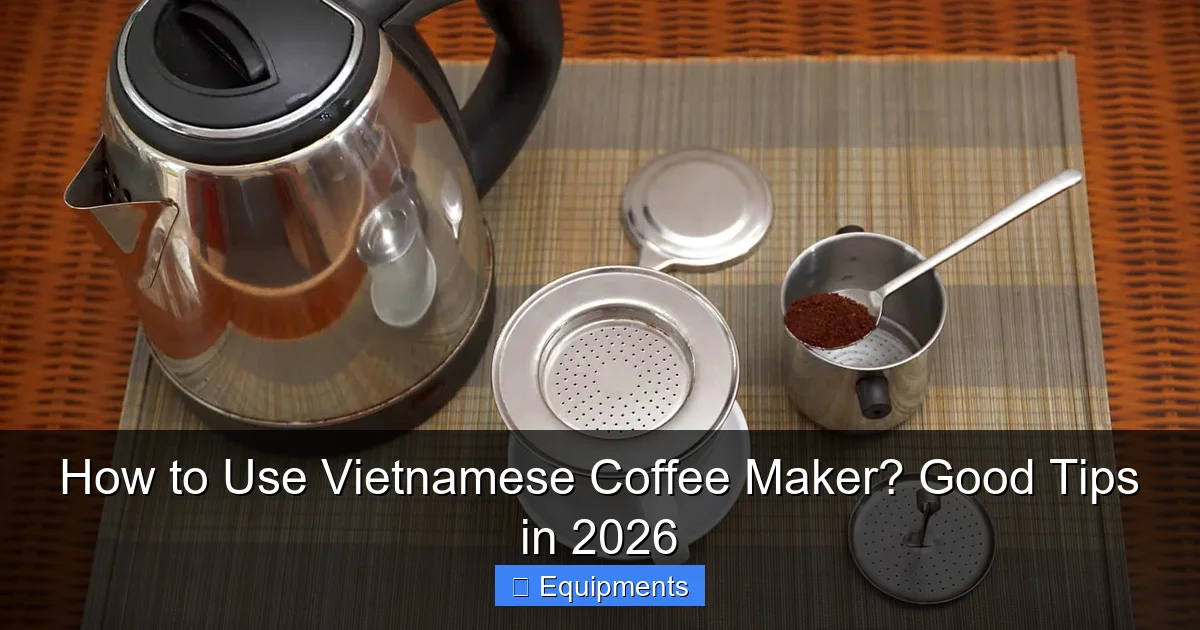
Before you brew, you must know your instrument. A traditional Vietnamese coffee maker is a simple, gravity-driven metal filter, typically made of stainless steel or aluminum. It consists of four main parts: the base, the filter chamber (with tiny holes), the tamper/press, and the lid. Its genius lies in its simplicity and control. Unlike paper filters that absorb oils, the metal phin allows all the natural coffee oils and fine sediments to pass through, creating that signature full-bodied, almost syrupy texture. In 2026, you’ll find various designs—some with a screw-down tamper for consistent pressure, others with a simple press. The principles, however, remain universal.
The Anatomy of a Phin Filter
Take a moment to examine your phin. The filter chamber should sit snugly on your cup or mug. The holes at the bottom are tiny—this is crucial. They are designed to hold back the coarse coffee grounds while allowing the liquid to drip through slowly. The tamper fits perfectly inside the chamber. Its purpose is to compress the coffee bed, creating a uniform path for water. The lid isn’t just a cover; it helps retain heat during the brewing process. Understanding how these parts interact is the first step to mastery. A warped chamber or a tamper that doesn’t fit snugly will lead to inconsistent extractions.
Why the Phin is Perfect for 2026 Coffee Trends
In an era of single-serve pods and complex machines, the phin is the antithesis of waste. It’s zero-waste (no paper filters), incredibly durable, and gives you complete control over your brew. It aligns perfectly with the 2026 trends of mindful consumption, sustainability, and the appreciation of craft. It also produces a concentrate, which is versatile—use it for iced drinks, mix it with milk alternatives, or dilute it for a strong hot coffee. It’s a tool for experimentation, connecting you directly to the raw product.
Choosing the Right Coffee and Grind: The Foundation of Flavor
This is the most critical step where most beginners fail. The phin demands a specific grind. Think of it like this: the grind size is the regulator for water flow. You need a coarse grind, similar to what you’d use for a French press. If the grounds are too fine (like for espresso or a drip cone), they will clog the tiny holes, creating immense pressure. The water will struggle through, over-extracting the fines and producing a bitter, muddy, and harsh cup. If the grind is too coarse (like for cold brew), the water will gush through too quickly, under-extracting the coffee and leaving you with a sour, weak, and watery brew.
Visual guide about How to Use Vietnamese Coffee Maker? Good Tips in 2026
Image source: crazycoffeebean.com
Grind Size Explained: Visual and Tactile Guide
What does “coarse” really mean? It should feel like raw sugar crystals or coarse sea salt. You should be able to clearly see and feel individual particles. They should not be powdery. If you’re grinding at home, set your burr grinder to a French press setting. If you’re buying pre-ground, look for labels that say “French press” or “coarse.” Never use pre-ground coffee meant for automatic drip machines for your phin. It is almost always too fine. For the best 2026 experience, invest in a small hand grinder or a quality burr grinder. Grinding your beans fresh, to the correct size, right before brewing is the single biggest upgrade you can make.
Bean Selection: Robusta vs. Arabica and Blends
Traditional Vietnamese coffee is famously made with robusta beans, known for their high caffeine content, bold, nutty, and sometimes chocolatey flavor, and a thicker, more viscous body. They often have a more bitter edge, which balances beautifully with sweetened condensed milk. In 2026, many roasters offer beautiful robusta or robusta-arabica blends specifically crafted for phin brewing. If you prefer a brighter, fruitier, or less bitter profile, seek out a dark roast arabica or a blend with a higher arabica percentage. The key is a dark roast; light roasts can taste grassy and sour when brewed as a concentrated phin coffee. Experiment to find your perfect match.
The Step-by-Step Brewing Process: Your Ritual in Action
Now, let’s put it all together. The process is fixed, but your mindfulness makes it perfect. Gather your phin, a sturdy cup (ceramic or glass is ideal, as it won’t absorb heat), your coarse coffee, hot water, and optionally, sweetened condensed milk and a spoon.

Visual guide about How to Use Vietnamese Coffee Maker? Good Tips in 2026
Image source: utensilsforcoffee.com
Step 1: Assemble and Prime
Place the phin base on your cup. Ensure the cup is stable and the phin sits evenly. Rinse the phin chamber and tamper with hot water. This preheats the metal, preventing it from drawing heat away from your brew and ensuring a more consistent temperature. Give it a quick shake to remove excess water.
Step 2: Add Coffee and Tamp
Open the lid and add 2-3 tablespoons (adjust to your phin size and taste) of your coarse ground coffee into the chamber. Gently tap the chamber on the table to level the grounds. Now, place the tamper on top. Apply firm, even pressure straight down. You should feel a slight resistance. The goal is to create a flat, compacted “puck” of coffee. Don’t stand on it—just press with the palm of your hand until it feels solid. This compressed bed is what forces the water to travel slowly through all the coffee particles, extracting evenly.
Step 3: The Bloom (30 Seconds)
Pour just enough hot water (just off the boil, ~200°F) to saturate all the grounds—about 1-2 ounces (30-60ml). You’ll see the coffee expand and bubble slightly. This is the bloom, where CO2 is released. Let it sit undisturbed for 30 seconds. Skipping this step can lead to uneven extraction and a sour taste, as trapped gas pushes water away from parts of the coffee bed.
Step 4: The Slow Pour (4-6 Minutes)
This is where patience pays off. Slowly pour the remaining hot water into the chamber in a steady, circular motion. Do not pour directly onto the metal sides; aim for the center of the coffee bed. The water level should never rise above the top of the chamber’s walls. As it drips down, you should see a steady, honey-like stream of dark coffee concentrate falling into your cup. The entire process from the start of pouring to the last drop should take between 4 and 6 minutes. If it’s finishing in 2 minutes, your grind is likely too coarse or your tamp too light. If it’s still dripping after 8 minutes, your grind is too fine or you tamped too hard. Watch the drip rate—it’s your main feedback tool.
Step 5: Stir, Serve, and Customize
Once dripping stops, remove the phin. The concentrate in your cup will be thick and dark. Give it a gentle stir to integrate any settled sediments. For classic cà phê sữa đá, add 2-3 tablespoons of sweetened condensed milk to a tall glass, fill halfway with ice, then pour the hot coffee concentrate over the ice. It will create a beautiful gradient. For hot coffee, you can drink it black (a cà phê đen) or add a splash of hot water or milk to your preferred strength. The concentrate is also a fantastic base for coffee cocktails or desserts.
Troubleshooting Common 2026 Brewing Problems
Even with the best intentions, things can go awry. Here’s how to diagnose and fix the most common issues, turning failures into learning experiences.

Visual guide about How to Use Vietnamese Coffee Maker? Good Tips in 2026
Image source: homegrounds.co
“My coffee is bitter and harsh.”
Diagnosis: This is almost always over-extraction. The water stayed in contact with the coffee grounds for too long, pulling out bitter compounds.
- Fix 1: Your grind is too fine. Make it coarser.
- Fix 2: You tamped too hard, compacting the bed excessively. Use a gentler press.
- Fix 3: Your water is boiling. Let it sit for 30 seconds after boiling to drop to ~200°F.
- Fix 4: You used a light roast bean. Darker roasts are more forgiving and suited for this method.
“My coffee is weak, sour, and watery.”
Diagnosis: This is under-extraction. The water passed through too quickly, failing to dissolve the flavorful compounds.
- Fix 1: Your grind is too coarse. Make it finer.
- Fix 2: Your tamp was too light or uneven. Ensure a firm, flat press.
- Fix 3: You poured the water too fast. Slow down your pour dramatically.
- Fix 4: You didn’t do a bloom. Always saturate the grounds first and wait 30 seconds.
“It’s dripping too slowly/not at all.”
Diagnosis: The filter is clogged.
- Fix 1: Grind is definitely too fine. This is the prime culprit. Coarsen it significantly.
- Fix 2: There may be a fine sediment “cap” formed on top from previous brews if you didn’t clean it well. Disassemble and clean the filter holes thoroughly with a small brush or toothpick.
“It’s channeling and dripping around the edges.”
Diagnosis: Water is finding a path of least resistance around the coffee puck, not through it.
- Fix 1: Your tamp is uneven. The coffee bed is slanted. Practice pressing straight down with even force.
- Fix 2: You didn’t level the grounds before tamping. Tap the chamber to settle them first.
- Fix 3: There’s a gap between the filter chamber and your cup. Ensure your cup’s rim is clean and the phin sits flush.
Advanced Tips for 2026: Elevating Your Phin Game
Once you’ve mastered the basics, it’s time to refine. The phin is a tool of nuance, and small adjustments yield big rewards.
Water Science: Filtration and Temperature Control
In 2026, we understand water is 98% of your coffee. Use filtered water, not straight tap water. Chlorine and minerals can distort flavor. For temperature, an electric gooseneck kettle with a temperature setting is a game-changer. Set it to 200°F (93°C) for consistent results. If you don’t have one, boil water and let it rest for 45-60 seconds in your preheated mug or a separate vessel before pouring.
Pre-infusion and Agitation Techniques
After your 30-second bloom, try a gentle “stir” with a spoon or chopstick before continuing your pour. This small agitation helps break the crust and ensures all grounds are fully immersed, leading to a more uniform extraction. Some baristas even do a second, very small pour after the initial bloom to re-saturate any dry spots before the main pour.
Experimenting with Ratios and Recipes
The standard ratio is about 1:4 to 1:5 coffee to water (e.g., 3 tbsp coffee to 12 oz water). But play! For a more intense concentrate for drinks, use less water. For a more traditional, drinkable black coffee, use a bit more water or add a splash of hot water after brewing. Explore bean origins: a Sumatran robusta for earthy intensity, a Vietnamese arabica for a smoother, floral note. The phin is your laboratory.
Sustainability and Longevity
Your stainless steel phin can last decades. To keep it in top shape for 2026 and beyond, avoid the dishwasher (detergents can pit the metal and leave residue). Hand-wash with mild soap and a non-abrasive sponge, paying special attention to the filter screen. Use a toothbrush to clean the holes. Dry it completely before storing to prevent water spots and potential rust on lower-quality steels. A well-cared-for phin is an heirloom.
Cleaning and Maintenance: The Unsung Hero of Flavor
This cannot be stressed enough. Coffee oils are volatile and become rancid quickly. A dirty phin will make even the best beans taste stale, sour, and unpleasant. The residue from one brew will contaminate the next.
After Every Brew: The Quick Rinse
Immediately after brewing, disassemble the phin. Take the filter chamber off the base and separate the tamper. Rinse every single piece under very hot running water. Use your fingers to rub the filter screen clean. The fine grounds will wash away easily when fresh. Shake off excess water. This 30-second habit is the most important one you can develop.
Weekly Deep Clean
Once a week, or if you notice a buildup of dark oil, give it a deeper clean. Use a soft brush (an old toothbrush is perfect) and a drop of unscented dish soap to scrub the filter screen, the inside of the chamber, and the tamper. Rinse *extremely* thoroughly under hot water to remove all soap residue. Soap left in the holes will taste terrible. Alternatively, you can soak the parts in a solution of hot water and baking soda, then rinse.
Storage and Long-Term Care
Always store your phin completely dry. Air-dry it on a rack or towel before putting it away. If you have a lower-quality aluminum phin, be extra vigilant about drying to prevent oxidation. For stainless steel, a occasional wipe with a little white vinegar diluted in water can help remove any hard water spots. Your phin is a workhorse; treat it well, and it will deliver perfect coffee for years.
Conclusion: Embrace the Slow Coffee Movement
Using a Vietnamese coffee maker is more than a brewing method; it’s a pause button in your day. It’s the tactile feel of coarse grounds, the sound of the first drip, the anticipation as the dark liquid pools in your cup. In 2026, with our world moving at light speed, this simple ritual grounds us—literally and figuratively. You now have the knowledge: the right grind, the proper tamp, the patient pour. The rest is practice and preference. Brew a cup, take a sip, and adjust. Make it your own. Whether you drink it black, with creamy condensed milk, or as a base for a new creation, you are now a practitioner of a beautiful, ancient, and deeply satisfying craft. Your perfect cup of Vietnamese coffee awaits. All it takes is a phin, some good beans, and a few minutes of your time.
Frequently Asked Questions
What is the ideal grind size for a Vietnamese coffee maker?
The ideal grind is coarse, similar to raw sugar or sea salt. It should feel gritty, not powdery. This prevents clogging and allows for the proper 4-6 minute slow drip. Pre-ground “French press” or “coarse” settings are perfect.
What water temperature should I use?
Use water just off the boil, between 195-205°F (90-96°C). Boiling water (212°F/100°C) will scorch the coffee, creating bitterness. Letting it sit for 30-45 seconds after boiling usually achieves the perfect temperature.
Why is my Vietnamese coffee so bitter?
Bitterness usually means over-extraction. The most common causes are: a grind that is too fine, tamping the coffee too hard, using water that is too hot, or using a light roast bean. Try a coarser grind, a gentler tamp, and ensure your water temperature is correct.
Can I reuse the coffee grounds from my phin?
Technically you can, but it’s not recommended. The first brew extracts the vast majority of the soluble compounds. A second brew will be significantly weaker, more sour, and lack flavor. It’s best to use fresh grounds for each cup to enjoy the full, intended profile.
How often should I clean my Vietnamese coffee maker?
You should do a quick hot water rinse after every single use to remove coffee oils and fines. Once a week, perform a deeper clean with a soft brush and a drop of mild soap, rinsing extremely thoroughly. Always store it completely dry.
Can I use pre-ground coffee from the store?
You can, but you must be very careful about the grind size. Most standard pre-ground coffee is too fine for a phin. Look specifically for brands labeled “French Press” or “Coarse Grind.” For the best results, buying whole beans and grinding them yourself to the correct coarse setting is highly recommended.