Storing sugar correctly is one of the simplest yet most overlooked kitchen skills. Proper sugar storage prevents hardening, clumping, and insect infestations, ensuring your staple is always ready for baking and sweetening. The core principle is protecting it from moisture and air using airtight containers in a cool, dark, dry place. Different sugars have slightly different needs, but the fundamental rules remain the same for all granulated, powdered, and brown varieties.
Key Takeaways
- Use Airtight Containers: Transfer sugar from its original bag into a truly airtight container (glass, heavy plastic, or metal) to block moisture and odors.
- Fight Moisture Relentlessly: The #1 enemy of sugar is humidity. Store in a consistently dry environment; never store above the stove or near the dishwasher.
- Control Temperature & Light: A cool, dark pantry or cupboard is ideal. Heat and sunlight can cause sugar to caramelize slightly and attract pests.
- Prevent Pest Infestation: Airtight storage is your primary defense. For long-term storage, consider adding a food-safe desiccant packet to absorb any stray moisture.
- Different Sugars, Similar Rules: Brown sugar needs extra moisture retention; powdered sugar is prone to odor absorption. Adjust storage slightly for each type.
- Label and Date: Always label containers with contents and date. Sugar has an indefinite shelf life for safety, but quality degrades over time.
- Regular Checks: Give stored sugar a quick glance and feel every few months to catch any moisture or pest issues early.
📑 Table of Contents
- Why Storing Sugar Properly Isn’t Just a Suggestion, It’s a Necessity
- The Golden Rules of Sugar Storage: Your Foundation for Success
- Choosing Your Arsenal: The Best Containers for Storing Sugar
- Tailoring Your Strategy: How to Store Different Types of Sugar
- Long-Term Storage and Advanced Tips for the Prepared Pantry
- Troubleshooting: What to Do When Storage Goes Wrong
- Conclusion: Sweetness Preserved
Why Storing Sugar Properly Isn’t Just a Suggestion, It’s a Necessity
You open your pantry, ready to whip up a batch of chocolate chip cookies. You reach for the bag of granulated sugar, and instead of a free-flowing cascade of sweetness, you’re met with a solid, rock-hard brick. Or worse, you find tiny beetles crawling through your sugar, a sure sign of a dreaded pantry pest infestation. These scenarios are more common than you’d think, and they all stem from one thing: improper sugar storage. Knowing how to store sugar correctly is a fundamental kitchen skill that saves money, prevents waste, and protects your ingredients.
Sugar, in all its forms, is a hygroscopic substance. This is a fancy word meaning it loves to absorb moisture from the air. That’s its nature. When it absorbs enough moisture, the crystals begin to dissolve and then recrystallize into a solid mass. It also acts like a sponge for odors, absorbing the smells of nearby spices, coffee, or stale air. Furthermore, an open bag of sugar is an open invitation to tiny invaders like pantry moths, weevils, and ants. The good news? Stopping all of this is remarkably simple and inexpensive. It comes down to creating a fortress around your sugar using the right container in the right environment. This guide will walk you through every step, ensuring your sugar stays as fresh and usable as the day you bought it, potentially for years.
The Golden Rules of Sugar Storage: Your Foundation for Success
Before we dive into specific sugar types, let’s establish the non-negotiable, universal principles that apply to storing any sugar. Think of these as the commandments of the sweet pantry. If you follow these, you’ve won 90% of the battle.
Visual guide about How to Store Sugar
Image source: storables.com
Rule #1: Airtight is Everything
The single most important factor in how to store sugar is an airtight seal. The original paper or plastic bags sugar comes in are not designed for long-term storage. They are permeable to air and moisture. Your first task after bringing sugar home is to transfer it to a container that creates a complete barrier.
- What to use: Glass jars with rubber seals and clamping lids (like Mason jars), high-density polyethylene (HDPE) plastic containers with locking lids and silicone gaskets, or metal tins with tight-sealing lids. Avoid thin plastic containers that can become brittle and crack.
- Key test: After sealing, try to smell the container’s contents through the lid. If you can detect any aroma, it’s not truly airtight.
Rule #2: Moisture is Public Enemy #1
As mentioned, sugar’s moisture-loving nature is the root cause of clumping and hardening. Your storage location must be consistently dry. This means:
- NO storage above the stove, next to the dishwasher, or under the sink. These are hot, humid zones.
- Avoid exterior walls in humid climates, as they can accumulate condensation.
- Ensure your container is completely dry before adding sugar. A damp spoon or wet hands can introduce enough moisture to start a clump.
Rule #3: Cool and Dark Wins the Race
Heat accelerates chemical reactions (like slight caramelization) and can make any residual moisture more active. Light, especially direct sunlight, can fade sugar and contribute to warmth. A consistently cool (room temperature, 65-75°F / 18-24°C) and dark cupboard or pantry is the perfect spot. This also helps deter pests, which are less active in cooler, darker areas.
Choosing Your Arsenal: The Best Containers for Storing Sugar
Not all containers are created equal. The best container for sugar storage is one that you will actually use and maintain. Let’s compare the top contenders.
Visual guide about How to Store Sugar
Image source: storables.com
Glass Jars: The Classic Champion
Glass is non-porous, meaning it won’t absorb odors or flavors and won’t leach chemicals. It’s easy to see the contents and check for moisture. Look for jars with a two-piece lid: a flat metal disc with a sealing compound and a ring that screws down. For the ultimate seal, consider jars with a glass lid and a rubber gasket clamped down with a metal latch. They are dishwasher safe for easy cleaning.
Heavy-Duty Plastic: The Practical Workhorse
Food-grade plastic containers (look for BPA-free and #2 or #5 recycling codes) are lightweight, shatterproof, and often more affordable. The key is quality. Cheap, thin plastic containers can warp, crack, and lose their seal over time. Invest in reputable brands known for airtight kitchen storage. Ensure they have a silicone gasket around the lid.
Metal Tins: The Pest-Proof Fortress
Airtight metal tins, often used for tea or coffee, are excellent. They are completely impervious to light and pests cannot chew through them. They are great for long-term storage or for storing sugar in a basement or garage where pests might be a bigger concern. Ensure the lid has a deep rim and a sealing gasket.
Pro Tip: Regardless of material, choose a container with a wide mouth. It makes scooping sugar out much easier and prevents you from having to pour it, which can cause spills and introduce moisture from the air.
Tailoring Your Strategy: How to Store Different Types of Sugar
While the golden rules apply to all, each type of sugar has its own personality and minor quirks that require a slight adjustment in storage strategy.
Visual guide about How to Store Sugar
Image source: storables.com
Granulated White Sugar: The Simple, Robust One
This is the easiest. Follow the golden rules exactly. An airtight glass jar in a cool, dry pantry is perfect. Because it is so refined and dry, it has an incredibly long shelf life if kept dry—essentially indefinite for safety and quality. Its main threats are moisture (causing clumps) and pests (if the seal is broken).
Brown Sugar (Light & Dark): The Moisture Lover
Brown sugar is granulated sugar with molasses reintroduced. This molasses is what gives it moisture, softness, and its characteristic flavor. The goal with brown sugar is NOT to keep it bone dry, but to maintain its perfect moisture level.
- Best Method: Store in an airtight container. The container should be truly sealed to prevent it from drying out and hardening. You can also place a small piece of terra cotta (soaked in water and blotted dry) or a dedicated brown sugar saver in the container. These slowly release moisture to keep the sugar soft.
- If it hardens: Place the sealed container in the microwave with a cup of water and heat in 30-second bursts, breaking it up with a fork between bursts. Or, place a slice of fresh bread or an apple wedge in the container for a few hours; the sugar will absorb the moisture from the bread/fruit.
- Do NOT store in the fridge. The refrigerator is a humid environment and will cause the sugar to absorb moisture from the air inside, making it clumpier.
Powdered (Confectioners’) Sugar: The Odor Sponge
Powdered sugar is finely ground granulated sugar with a small amount of cornstarch to prevent caking. Its massive surface area makes it incredibly absorbent of odors and moisture.
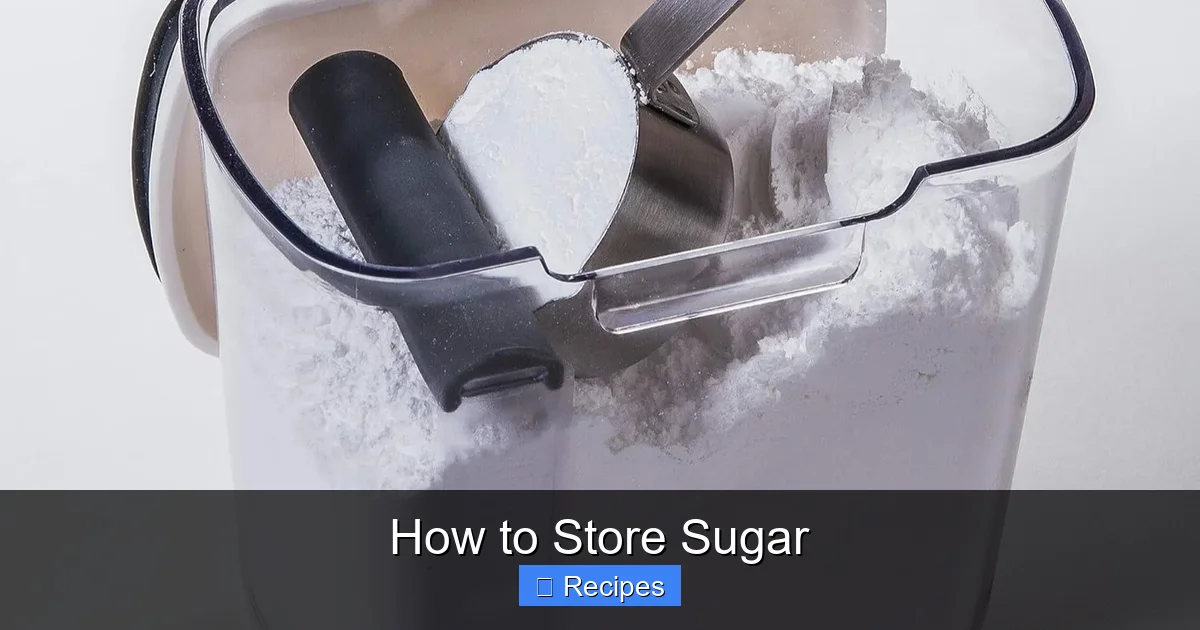
- Storage: An absolutely airtight container is non-negotiable. Keep it far away from strong-smelling spices, coffee, onions, or cleaning supplies. Glass is an excellent choice here because plastic can sometimes retain odors over time.
- Use Dry Utensils: Always use a completely dry spoon or sifter. Any moisture will cause it to form pasty lumps.
- Sifting: Before use, sift it even if it seems free-flowing. This breaks up any minor lumps and aerates it.
Specialty Sugars (Raw, Turbinado, Demerara): The Crystals
These larger-crystal, less-processed sugars have a natural molasses coating. They are less hygroscopic than brown sugar but more so than white sugar. Store them like granulated sugar in an airtight container. Their larger crystals make them less prone to hardening but more susceptible to absorbing odors if not sealed properly.
Long-Term Storage and Advanced Tips for the Prepared Pantry
If you buy sugar in bulk (hello, 25-pound bag!) or are building a preparedness pantry, you need strategies for storing sugar for years, not just months.
The Food-Grade Bucket Method
For bulk storage, food-grade 5-gallon buckets with gamma seal lids are the gold standard. These buckets are made of HDPE plastic, are stackable, and the gamma seal lid twists on and off for easy access while providing an airtight, pest-proof seal. Place the entire bag of sugar inside the bucket, squeeze out as much air as possible, and seal. For ultimate protection, you can use a mylar bag liner inside the bucket before adding the sugar, and add an oxygen absorber packet. This method can keep sugar perfectly preserved for 5+ years.
To Freeze or Not to Freeze?
Freezing sugar is a debated topic. The theory is that freezing kills any tiny insect eggs that might be present (a risk with any dried good purchased from a store). However, it is generally unnecessary and can create more problems than it solves.
- The Risk: Condensation. When you take a frozen container out of the freezer, water vapor from the warm air will condense on the cold sugar inside the container. This introduces moisture, the very thing you’re trying to avoid. If you must freeze, let the container come to room temperature completely before opening it, while still sealed.
- Verdict: If you buy sugar from a reputable source and store it airtight from the start, freezing is an extra step with high risk of error. Your airtight container in a cool pantry is sufficient.
Labeling and the “First In, First Out” System
Write the contents and the date of purchase or storage on the lid of every container with a permanent marker. Adopt a “first in, first out” system. Place new containers behind older ones. This simple habit prevents sugar from being forgotten in the back of the pantry for a decade.
Troubleshooting: What to Do When Storage Goes Wrong
Even with the best intentions, problems can arise. Here’s your action plan.
Problem: Sugar is Rock Hard
Solution: For granulated or powdered sugar, break it up with a fork and spread it on a baking sheet. Place in a warm oven (200°F/95°C) for 10-15 minutes, stirring occasionally, until it dries out and breaks apart easily. Return it immediately to its airtight container. For brown sugar, use the bread/apple or microwave method described earlier.
Problem: You See Weevils or Moths
Solution: This is a contamination event. Immediately seal the infested container and dispose of it in an outdoor trash can. Do not compost. Thoroughly inspect all other dried goods in the immediate area (flour, cereal, spices, pet food). Empty the entire pantry, vacuum every shelf and corner, and wipe down with a vinegar solution. Store all future goods in hard-sided, airtight containers. The infestation likely came from an infected product, so your new storage protocol is critical.
Problem: Sugar Smells Strange
Solution: Sugar has absorbed an odor from its environment. Unfortunately, there is no fix. The flavor is compromised. Use it for a purpose where the off-flavor won’t be detected (e.g., in a strongly spiced gingerbread or a barbecue rub with lots of other flavors). For future storage, move to a glass container and ensure your pantry is odor-free.
Conclusion: Sweetness Preserved
Mastering how to store sugar is a quiet victory in the kitchen. It’s the difference between a smooth, predictable baking experience and a frustrating, wasteful one. By committing to the simple trifecta of airtight containers, a dry environment, and cool darkness, you protect your investment and your recipes. Take a few minutes after your next grocery trip to transfer your sugars into their proper homes. This small act of organization pays dividends in texture, flavor, and peace of mind for months and years to come. Your future self, mid-recipe, will thank you.
Frequently Asked Questions
Can I store sugar in the refrigerator?
No, storing sugar in the refrigerator is not recommended. Refrigerators are humid environments, and sugar will absorb that moisture, leading to clumping and hardening. The exception is for very humid climates where even a pantry isn’t dry enough, but even then, an ultra-airtight container in the coolest, driest part of the pantry is better.
Can I mix different types of sugar in the same container?
It’s best to store different sugars separately. Each has a different moisture content and can absorb odors differently. Mixing them can lead to texture issues (e.g., brown sugar moisture making granulated sugar clump) and makes it difficult to use the exact type a recipe calls for.
Is it safe to eat sugar that has hardened or has insects?
Hardened sugar is perfectly safe to eat once it’s reconditioned (dried and broken up). Sugar with a live insect infestation should be discarded entirely, as the insects and their waste are contaminants. The surrounding area must be thoroughly cleaned to prevent spread.
What is the absolute best container for sugar?
The absolute best container is a glass jar with a rubber gasket and a clamping or screw lid that creates an airtight seal. Glass is non-porous, won’t leach, and is easy to clean and check for moisture. The wide-mouth style is ideal for easy scooping.
How long can sugar actually be stored?
If kept perfectly dry and airtight, white granulated sugar has an indefinite shelf life for safety and can retain its quality for many years. Brown sugar will retain its moisture for about 18 months to 2 years in an airtight container before it may start to dry out. Powdered sugar is best used within 2 years for optimal flavor and texture.
My sugar is slightly lumpy but not rock hard. What should I do?
For minor lumps in granulated or powdered sugar, simply break them up with a fork or whisk. Then, stir the sugar and pour it into a new, completely dry airtight container. You can also toast it lightly on a baking sheet at 300°F (150°C) for 5-10 minutes to drive off any trace moisture, then let it cool completely before resealing.