Boiling water in an Instant Pot without the lid is a specific technique, not a standard boiling method. It relies entirely on the appliance’s sealed system and the steam release valve to manage pressure. This method is used for recipes requiring high-moisture steam pressure but no direct liquid contact, or when the lid is unavailable. It is absolutely critical to never force the lid off during operation and to always use the correct valve setting. Understanding this process ensures safety and successful results for tasks like sterilizing jars or cooking certain foods.
So, you want to boil water in your Instant Pot, but the lid is MIA, in the dishwasher, or you’re just plain curious. First, let’s get one thing absolutely clear: when we talk about “boiling water in an Instant Pot without a lid,” we are not talking about the same gentle, open-air simmer you’d get on a stovetop. That’s impossible because an Instant Pot is, by design, a sealed pressure cooker. The “lid” isn’t just a cover; it’s an integral part of a complex safety and pressure-regulating system. What you’re really asking is how to create a pressurized, steam-filled cooking environment using your Instant Pot’s inner pot and its sealing mechanisms, while the physical lid component is absent. This is a highly specific, niche technique with very particular applications and, more importantly, very strict safety rules.
The core concept hinges on understanding that the Instant Pot’s sealing ring, float valve, and steam release valve work together to create an airtight (or nearly airtight) chamber. When you add liquid and heat the base, that liquid turns to steam. With the lid properly locked on and the steam release valve set to “Sealing,” that steam has nowhere to go. Pressure builds, which raises the boiling point of the water, allowing it to cook food faster and at higher temperatures. When we remove the physical lid, we are essentially disabling the primary locking mechanism and the secondary sealing ring housing. The only thing standing between you and a room full of scalding steam is the steam release valve itself, sitting in its hole on the control panel side. Therefore, “boiling water without the lid” is really about using the pot as a high-pressure steam generator, with the valve as the sole pressure release point. It’s a procedure for specific scenarios, like sterilizing canning jars when you’ve misplaced the lid, or for certain advanced cooking techniques where you want extreme steam pressure without the lid’s condensation dripping back onto the food. But it is not a casual, everyday shortcut.
Key Takeaways
- Safety First: Never attempt to remove or replace the lid while the Instant Pot is pressurized or hot. The locking mechanism and steam are extremely dangerous.
- Valve is Key: The “lid” in this technique is functionally replaced by the sealed pot and the steam release valve set to “Sealing.” The valve controls all pressure buildup and release.
- Purpose-Specific: This method is for creating a pressurized steam environment (like for canning or某些 steamed dishes), not for simply simmering or reducing a liquid openly.
- Liquid Minimum: You must still add the minimum required liquid (usually 1 cup) to generate sufficient steam for pressure cooking, even without the physical lid.
- Natural Release Essential: After cooking, pressure must release naturally for the full cycle. Quick release can cause violent bubbling and liquid expulsion through the valve.
- Not for All Recipes: Most standard Instant Pot recipes require the lid. Boiling water without it is a niche technique for specific culinary or sterilization tasks.
- Clean Valve: Ensure the steam release valve is clean and unobstructed before starting. A blocked valve is a major safety hazard and will prevent pressure from building.
[FEATURED_IMAGE_PLACEHOLDER]
📑 Table of Contents
- Why Would You Even Do This? Understanding the Purpose
- The Critical Safety Protocol: Non-Negotiable Rules
- Step-by-Step: How to “Boil” (Pressurize) Water Without the Lid
- The Science Behind the Steam: Why It’s Not Real Boiling
- Common Mistakes and Catastrophic Failures
- Alternative Methods: Safer Ways to Achieve Your Goal
- Conclusion: Knowledge is the Best Safety Tool
Why Would You Even Do This? Understanding the Purpose
Before we dive into the “how,” we must address the “why.” Boiling water in an Instant Pot without its lid is not a recommended practice for general cooking. It’s a workaround or a specialized technique. Here are the primary, legitimate reasons someone might attempt this:
Sterilizing Canning Jars or Equipment
This is the most common and valid reason. If you are water bath canning or pressure canning and need to sterilize your jars, you typically place them in the canner with an inch or two of water and process them. If your Instant Pot lid is unavailable but you need to sterilize a few small jars quickly, you can place them in the inner pot, add about 1-2 cups of water, and run a “Steam” or “Pressure Cook” cycle. The high-pressure steam will sterilize the jars effectively. However, for true, safe pressure canning of low-acid foods, you must use a lid that locks and a pressure canning-certified device. This is a sterilization hack, not a replacement for proper pressure canning.
Cooking Foods That Benefit from Intense, Dry Steam
Some chefs and advanced home cooks seek an ultra-dry, high-pressure steam environment for items like certain types of dumplings, puddings, or custards. The standard lid’s condensation drips back onto the food. By removing the lid, you eliminate that dripping. However, you lose the sealing ring’s ability to create a perfect seal, so pressure may not build as high or as consistently. This is an experimental technique with unpredictable results and is not for beginners.
The Lid is Genuinely Lost or Broken
Let’s be practical. Accidents happen. The lid could be cracked, the sealing ring might be torn and lost, or the entire lid assembly could be missing. In a pinch, if you need to cook something that requires pressure (like a tough cut of meat) and you have no lid, you might try this method as a last resort, understanding the significant risks and compromises. It is not a safe or reliable long-term substitute.
Educational Experiment
For the technically-minded, performing this experiment (with extreme caution) can teach you a lot about how pressure cookers work. You can observe how the steam release valve behaves under pressure without the lid’s secondary seal, understand the sound of a “sealed” system, and see the difference in pressure buildup time. This should only be done with water, never food, and with a safe, open area ready for the steam blast upon release.
For 95% of users, 95% of the time, you should never try to pressure cook without the lid. The risks—scalding steam, uneven cooking, potential damage to the pressure sensor, and voiding your warranty—far outweigh any perceived benefit. The following instructions are for those who understand the risks and have a specific, necessary purpose.
The Critical Safety Protocol: Non-Negotiable Rules
Before you even plug in the Instant Pot, you must internalize these safety rules. This is not a “tips” section; it is a survival guide. Ignoring these can cause severe burns, damage your kitchen, or ruin your appliance.
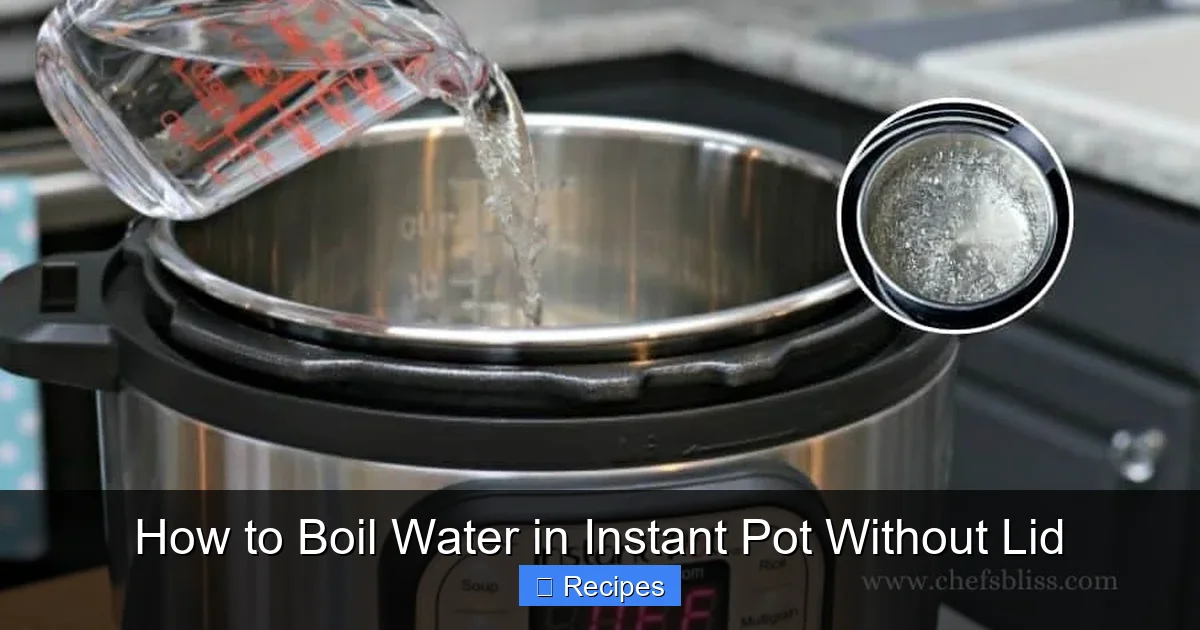
Visual guide about How to Boil Water in Instant Pot Without Lid
Image source: chefsbliss.com
Rule 1: The Steam Release Valve is Your Only Friend
With the lid off, the steam release valve (the small knob on the control panel side) is the only component designed to vent pressure. You must ensure it is clean, moves freely, and is set to the “Sealing” position (pointing away from you, usually with a blue or red indicator) for the cooking cycle. A blocked or faulty valve will cause pressure to build uncontrollably until something fails, usually the inner pot popping up or steam forcing its way out through the weakest seal, which could be around the base of the valve housing. Before starting, manually twist the valve back and forth a few times. Listen for it clicking. Give it a gentle pull upward to ensure it’s not stuck down.
Rule 2: Minimum Liquid is Still Mandatory
Your Instant Pot’s manual states a minimum liquid requirement, typically 1 cup (250ml) for a 6-quart model. This is not a suggestion; it’s a physics requirement. That liquid is what turns to steam to create pressure. Without enough liquid, you will not reach pressure, the “Burn” error will trigger (as the base overheats with no steam), and you will not cook your food. For this lidless technique, use at least the minimum, but consider adding 25-50% more (e.g., 1.5 cups) because some steam may escape more easily through the valve hole without the lid’s perfect seal, meaning you need more “fuel” to build pressure.
Rule 3: Never Force the Valve or Lid During Operation
If you suspect something is wrong—the valve is whistling excessively, you hear a hissing leak, or pressure isn’t building—do not try to adjust the valve, jiggle the inner pot, or force a lid on. The only safe action is to unplug the Instant Pot and allow it to cool completely. Forcing components under pressure is the fastest route to a steam explosion. The unit will naturally vent some steam during the pressure build-up phase (the “hisssss” sound). This is normal. A continuous, high-pitched whistle indicates it has reached pressure and is maintaining it by venting small amounts. A weak, sputtering hiss may indicate a poor seal or low liquid.
Rule 4: Natural Pressure Release is the ONLY Release Method
When the cooking cycle ends, you must let the pressure release naturally (NPR). This means doing nothing. Do not touch the steam release valve. Do not try to move the pot. The pressure will slowly dissipate as the steam inside condenses back into water. This can take 10-30 minutes. Quick release (QPR)—turning the valve to “Venting”—with the lid off is an act of profound stupidity. The pressurized water inside, now at temperatures well above 212°F (100°C), will instantly and violently flash into steam as it hits the lower-pressure atmosphere through the open valve. This creates a superheated geyser of boiling water and steam that will shoot straight out of the valve opening with immense force, scalding anything in its path. There is no safe way to quick-release without the lid on to direct and contain the initial blast.
Rule 5: Use Only for Water or Very High-Moisture Foods
Do not attempt this with dry foods, grains, or anything that can stick to the bottom and burn. The risk of a “Burn” error is already higher without the lid’s perfect seal. Use this technique only for: 1) Sterilizing jars (filled with water or empty), 2) A large volume of water itself (for experiment), or 3) Foods submerged in a generous amount of liquid (e.g., a soup or stew where the liquid level is at least halfway up the food). The liquid is your steam generator and your buffer against overheating.
Step-by-Step: How to “Boil” (Pressurize) Water Without the Lid
Assuming you have read, understood, and accept the risks and limitations, here is the procedural guide. We’ll use the goal of sterilizing two pint jars as our practical example.
Visual guide about How to Boil Water in Instant Pot Without Lid
Image source: indoorense.com
Step 1: Preparation and Inspection
Place your clean Instant Pot inner pot into the base. Ensure the base is dry and the heating element is clean. Inspect the steam release valve hole on the control panel side. Use a damp cloth or your finger to ensure no debris is inside the hole. Check the float valve (the small metal pin next to the steam release valve) moves up and down freely. Place two clean, empty pint jars into the inner pot. They should fit comfortably without touching the sides or each other too closely.
Step 2: Add Liquid
Pour 1.5 cups (375ml) of cool tap water into the inner pot, being careful not to pour it into the jars. The water level should be about 1/2 to 1 inch deep in the pot, surrounding the jars. This water is what will turn to pressurized steam, heating the jars to a sterilization temperature (above 212°F/100°C).
Step 3: Position the Steam Release Valve
Locate the steam release knob on the lid. Since the lid is not being used, you will find a similar-looking knob or button on the control panel of the Instant Pot base itself. This is the steam release valve for the unit. Push it down and turn it clockwise to the “Sealing” position. You should feel it click into place. On some models, it’s a push-button; ensure it is pushed all the way in. This closes the only vent path.
Step 4: Select Cooking Program
For sterilization, you want high pressure and steam. The “Steam” function is ideal. Press the “Steam” button. For sterilization, you typically need 10 minutes at high pressure. Use the “+” or “-” buttons to adjust the time to 10 minutes. Ensure the pressure level is set to “High” (some models have a “Pressure Level” button to toggle between High and Low).
Step 5: The Pressurization Phase (The “Boiling”)
Press “Start.” The Instant Pot will begin to heat. You will hear a low hum and then a hissing sound as the water heats and begins to evaporate. This hissing is steam being forced past the valve seal as pressure builds. After 5-15 minutes (depending on the amount of water and ambient temperature), the float valve will pop up. This is your signal that pressure has been reached. The hissing will change to a more steady, rhythmic whistle or a steady stream of steam. This is the “boiling” phase—your water is boiling at a temperature higher than 212°F due to the pressure, and that high-temperature steam is filling the chamber and sterilizing your jars. The water in the pot is now a boiling, pressurized liquid.
Step 6: Cooking Time and Natural Release
Once the float valve is up, the 10-minute timer will start. Let it run its full course. When it beeps and switches to “Keep Warm,” the heating element will turn off. DO NOTHING. Do not touch the valve. Do not try to open anything. Allow the unit to sit, undisturbed. The pressure will slowly drop. You will hear the hissing/whistling stop. After 15-25 minutes, the float valve will drop back down with a little clunk. Only then is it safe to proceed.
Step 7: Opening and Venting Residual Steam
Once the float valve is down, there may still be a small amount of residual pressure and steam in the pot. Slowly and carefully, using a utensil or oven mitt, turn the steam release valve to the “Venting” position. You will hear a final rush of steam. Stand clear of the valve opening. Once the steam stops hissing, you can carefully unlock and remove the inner pot. The jars and the water will be extremely hot. Use jar lifters or thick oven mitts. The water in the pot will have boiled down somewhat, and the jars will be sterilized.
The Science Behind the Steam: Why It’s Not Real Boiling
To truly understand this process, we need to clarify a scientific point. In your scenario, the water in the inner pot is boiling—it’s undergoing a phase change from liquid to vapor. However, the system’s behavior is dictated by pressure. At sea level, pure water boils at 212°F (100°C). When you seal a container and heat it, the vapor (steam) cannot escape. This increases the pressure inside the container. According to basic chemistry, the boiling point of a liquid increases with pressure. So inside your pressurized Instant Pot, the water might be boiling at 235°F (113°C) or higher, depending on the pressure level achieved. The “boiling” you hear and see (through the valve) is this superheated water turning to vapor and being forced out to regulate pressure.
Visual guide about How to Boil Water in Instant Pot Without Lid
Image source: indoorense.com
The key difference from stovetop boiling is containment and control. On a stovetop, boiling is an open system; bubbles of vapor freely rise and pop at the surface, and the temperature stabilizes at 212°F. In the Instant Pot (with or without the lid), it’s a closed system until the valve opens. The boiling point is variable and higher. The steam is also saturated with heat energy, which is why pressure cooking is so efficient. When you remove the lid, you compromise the “closed” part of that system. The valve must work harder to maintain pressure because there’s a larger, less defined leak path around the valve stem itself (which normally seals against the lid). This is why you might need more liquid and why pressure might not build as high or as quickly. The system is leaky, so it’s less efficient and less predictable. The “boiling” action is still happening in the pot, but the pressure-regulation drama is all happening at that single valve opening.
Common Mistakes and Catastrophic Failures
Given the dangers, let’s review the most frequent errors people make when attempting this, and their potentially disastrous outcomes.
Mistake: Forgetting the Minimum Water
You put two cups of rice and one cup of water into the pot, thinking it will pressure cook. Without enough liquid to generate steam, the heating element will superheat the tiny amount of moisture at the bottom. The “Burn” warning will eventually trigger, but before that, you may have already created a hot spot that scorches the pot. With no lid to contain the initial sparks of smoke, your kitchen fills with the smell of burnt food. Solution: Always, always use the minimum liquid. For experimental lidless runs, use even more.
Mistake: Using the “Venting” Position from the Start
You want to see the action, so you set the valve to “Venting” before starting. This is like trying to build a dam with the floodgates wide open. All the steam escapes immediately. Pressure will never build. The water will just simmer at 212°F on the bottom, possibly scorching. You’ll end up with boiled, not pressure-cooked, results and a “Burn” error. Solution: Valve must start on “Sealing.” Only move it to “Venting” after the full natural release cycle, when pressure is zero.
Mistake: Quick Releasing Under Pressure
This is the most dangerous. The timer beeps. You’re impatient. You twist the valve to “Venting.” BOOM. A torrent of explosively boiling water and high-pressure steam erupts from the valve opening. It can travel 3-5 feet with enough force to knock over small objects and cause third-degree burns in milliseconds. This is not a minor splash; it’s a pressurized blast. Solution: Never, ever quick release without the lid on to direct the initial blast into the venting area. Wait for the float valve to drop. It’s the only indicator of zero pressure.
Mistake: Assuming the Pot is “Sealed” Without the Lid
You think the inner pot’s rim and the base’s sealing surface create a good enough seal. They do not. The lid provides the primary seal via the large sealing ring. Without it, the system is leaky. You’ll get inconsistent pressure, longer cook times, and possibly the “Burn” error if steam escapes too much and the base overheats. Solution: Understand this is a compromised, inefficient process. Adjust expectations. Use it only for tasks where precise pressure isn’t critical, like sterilization.
Mistake: Trying to Put the Lid On Mid-Cycle
You hear a weird noise and panic, trying to slap the lid on. This is a recipe for disaster. The inner pot is under pressure, and the lid’s locking mechanism is not engaged. The sudden change in volume can cause the pressure to force the inner pot up or the lid to fly off. Solution: If something goes wrong, unplug the unit. Walk away. Let it cool completely for at least an hour before investigating.
Alternative Methods: Safer Ways to Achieve Your Goal
Given the risks, you should almost always seek an alternative. Here are safer, more reliable methods for common goals that might lead someone to consider the “no lid” hack.
For Sterilizing Jars: The Oven Method
This is the classic, safe, and effective method. Wash jars and lids. Place jars upright on a baking sheet in a cold oven. Set temperature to 225°F (107°C) and bake for 20 minutes. Turn off oven and leave jars inside until needed. The dry heat sterilizes perfectly. Lids can be sterilized by boiling in water for 10 minutes. No pressure, no steam, no risk of explosion. For water bath canning, you can boil the jars directly in a large stockpot on the stove—a method that has been used for centuries.
For Cooking Without a Lid: Just… Don’t Use Pressure
If your goal is simply to boil water or simmer food without a lid, use a regular pot on the stove or your Instant Pot’s “Slow Cook” function. The “Slow Cook” function on an Instant Pot operates with the lid off or on (you can use the glass lid), but it does not build pressure. It’s just a heating element with a temperature control, like a crockpot. This is the safe, intended way to cook “uncovered” in your Instant Pot. You get the convenience of the appliance without any pressure risks.
If the Lid is Broken: Order a Replacement
Instant Pot lids are not consumables, but they can break. Before resorting to dangerous workarounds, check the manufacturer’s website or customer service. You can often order a replacement lid or specific parts (like a new sealing ring or steam release valve) for a reasonable cost. This is the safest and most responsible long-term solution. Using a broken or missing lid compromises all safety systems.
For High-Pressure Steam Experiments: Use a Dedicated Steamer
If you are fascinated by high-pressure steam cooking, invest in a proper stovetop pressure canner or a commercial steamer. These are designed with robust, redundant safety systems and clear operating procedures for specialized tasks. Misusing a multi-cooker for experiments it was not designed for is asking for trouble.
Conclusion: Knowledge is the Best Safety Tool
Boiling water in an Instant Pot without its lid is a fascinating technical exercise that reveals the elegant simplicity of pressure cooking: heat + liquid + a sealed environment = pressure. It strips the process down to its bare components: the pot, the water, the heat source, and the single point of egress, the steam release valve. But that elegance is also its danger. With one redundant safety feature (the lid’s locking arms) and one primary seal (the sealing ring) removed, you are operating on a razor’s edge. The system is no longer “foolproof”; it’s “expert-only, high-risk.”
For the vast majority of cooking, your Instant Pot needs its lid. That lid is not an optional accessory; it is the heart of the machine’s safety and functionality. If you find yourself considering the lidless method, ask why. Is it for sterilization? Use the oven. Is it because the lid is missing? Order a replacement. Is it curiosity? Satisfy it with a pot of water on the stove, watching it boil at 212°F, and be grateful for the engineering that lets us safely harness steam at 240°F in our kitchens every day. Understanding how pressure works is empowering, but respecting its power is non-negotiable. The safest way to boil water in an Instant Pot is to put the lid on, set the valve, and let the machine do what it was brilliantly designed to do.
Frequently Asked Questions
Is it safe to pressure cook without the Instant Pot lid?
No, it is not safe for standard cooking. The lid contains critical safety locks and the primary sealing ring. Operating without it relies solely on the steam release valve, creating a high risk of scalding steam burns from leaks or explosive pressure release. It should only be attempted for specific, low-risk tasks like sterilizing jars by experts who understand the risks.
How long does it take to build pressure without the lid?
It will typically take longer to reach pressure than with the lid, often 25-50% more time. Without the lid’s perfect seal, more steam escapes around the valve stem during the initial heat-up, so the chamber fills with pressurized steam more slowly. Be patient and ensure you have the minimum liquid plus extra.
Can I use a different lid or foil as a substitute?
Absolutely not. Using any improvised lid (foil, another pot’s lid, etc.) is extremely dangerous. It will not lock into the Instant Pot’s safety mechanisms and can seal unevenly, leading to explosive pressure buildup or sudden, uncontrolled release. Only the manufacturer’s specific lid is designed to work safely with that model.
Will food cook properly without the lid on?
No, cooking will be inconsistent and inefficient. Pressure will be lower and less stable, leading to longer cook times and uneven results. Foods that require a tight seal for steam (like rice or beans) will likely fail, often resulting in a “Burn” error as liquid evaporates too quickly without proper pressure regulation.
Why is the steam release valve so important in this scenario?
It is the only pressure-regulated outlet. With the lid off, there is no secondary seal. The valve must constantly work to vent just enough steam to maintain a target pressure. If it becomes clogged, pressure has no controlled escape route and will build until the weakest point fails—usually the valve housing itself or the inner pot being forced upward.
What happens if I accidentally start a cycle without the lid?
The Instant Pot will likely still attempt to heat and build pressure. You will hear constant, loud hissing as steam escapes freely. It may never reach the pressure required to start the cooking timer, resulting in a “Burn” error after 10-20 minutes as the base overheats with insufficient steam. Unplug it immediately if you realize the mistake before it overheats.
Pingback: How to Make Poached Eggs in Water - kitchenandhouseware.com
Pingback: How to Boil Sweet Potatoes - kitchenandhouseware.com