An air fryer works not by frying, but by rapidly circulating super-heated air around food using a powerful fan and heating element. This convection process cooks and crisps food by removing surface moisture and triggering the Maillard reaction, all with little to no added oil. It’s a countertop convection oven, not a deep fryer. Understanding this key difference helps you use it effectively for healthier, crispy results.
You’ve seen the ads. You’ve heard the hype. A magical kitchen gadget that makes french fries, chicken wings, and even donuts with little to no oil. It promises crispy, golden-brown results without the guilt, the mess, or the vats of hot oil. It’s called an air fryer. But how does an air fryer work without oil? The secret isn’t magic—it’s brilliant, applied science. Let’s pull back the curtain and understand exactly what’s happening inside that sleek, countertop appliance. Because once you know the mechanics, you’ll become a vastly better, more confident air fryer chef.
The biggest misconception is the name itself. It’s not a fryer. It does not fry. The term “air fryer” is a brilliant piece of marketing that taps into our desire for crispy, fried foods without the downsides. In reality, your air fryer is a compact, high-velocity convection oven. It uses one primary tool: a powerful fan that circulates extremely hot air at speeds much faster than a traditional oven. This rapid air movement is the engine that creates the texture we associate with frying. Let’s break down the two core scientific processes that make it possible.
Key Takeaways
- It’s a Convection Oven: An air fryer is essentially a small, powerful countertop convection oven that uses a fan to circulate hot air at high speed.
- No Frying Occurs: The name is a marketing term; no oil is submerged or used for frying. Cooking is done via dry, forced-air convection.
- Crispness Comes from Dehydration & Maillard: Rapid air removes surface moisture, and high heat triggers the Maillard reaction (browning), creating crispiness without oil.
- Healthier, Not Magic: It significantly reduces fat and calories compared to deep frying but doesn’t automatically make all foods “healthy.”
- Technique is Key: Proper preheating, avoiding overcrowding, and shaking/tossing the basket are essential for even cooking and crisp results.
- Not for Everything: Foods with wet batters or heavy, dense doughs (like whole chickens or large cakes) often don’t cook well due to limited space and air circulation.
📑 Table of Contents
- 1. The Big Misconception: It’s Not Frying, It’s Convection
- 2. The Crispness Equation: Dehydration Meets the Maillard Reaction
- 3. The Health Halo: Separating Fact from Fiction
- 4. Mastering Your Air Fryer: Technique Over Technology
- 5. What Cooks Best (and Worst) in an Air Fryer
- 6. Beyond “Frying”: The Versatile Countertop Oven
- Conclusion: Embrace the Science, Ditch the Guilt
1. The Big Misconception: It’s Not Frying, It’s Convection
To understand how an air fryer works without oil, we must first kill the myth that it fries. Deep frying is a cooking method where food is completely submerged in hot oil, typically between 350°F–375°F (175°C–190°C). The oil conducts heat intensely and uniformly, cooking the food from the outside in and creating a barrier that seals in moisture. The result is a uniquely crispy exterior and a tender interior. Oil is the essential medium.
An air fryer uses zero oil as a cooking medium. Instead, it uses air. But not just any air. It uses air that has been heated to a high temperature (usually 400°F/200°C or more) and is then blasted around the cooking chamber by a fan located on top of the heating element. This is the definition of convection cooking: the transfer of heat via the movement of a fluid (in this case, air).
The Anatomy of Airflow: Why Design Matters
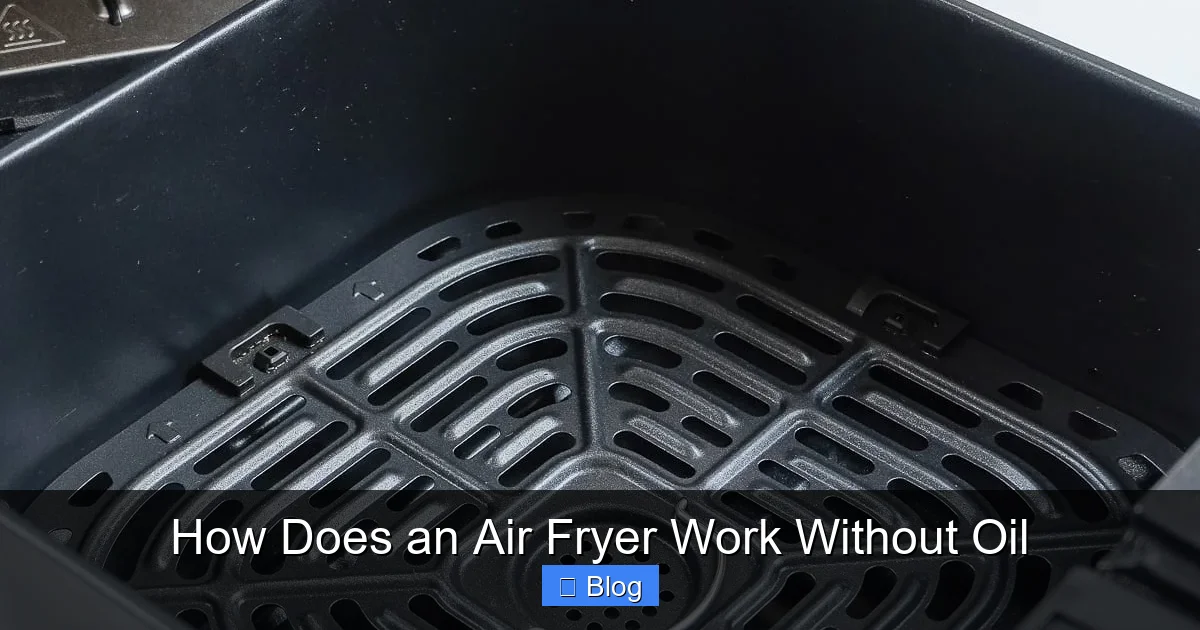
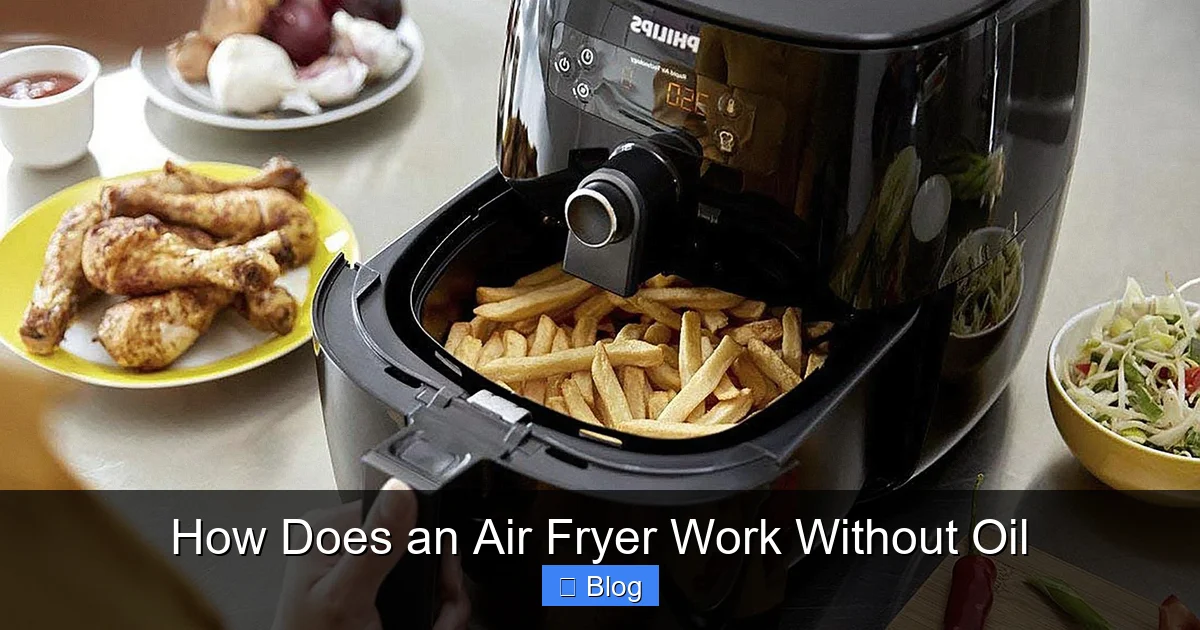
Look inside an air fryer. You’ll see a perforated basket or tray that holds the food. This design is critical. The holes allow the superheated air to flow through the food, not just around it. The fan, usually situated right above or below the heating element, creates a cyclonic vortex of air. This fast-moving air does three things simultaneously:
- Transfers Heat: The hot air molecules collide with the food’s surface, transferring kinetic energy (heat) rapidly.
- Removes Moisture: As the air moves, it acts like a powerful wind, wicking away evaporating water vapor from the food’s surface. This is the first step to crispiness—dryness.
- Ensures Even Cooking: The circulation eliminates hot and cold spots. In a conventional oven, hot air rises, creating uneven temperatures. The air fryer’s fan disrupts this, forcing the hot air to hit every angle of the food.
Because the cooking chamber is small (typically 3–6 quarts), this air reaches every nook and cranny incredibly quickly. The entire basket of food is essentially bathed in the same high-temperature environment. This efficiency is why an air fryer preheats and cooks much faster than a full-sized oven.
2. The Crispness Equation: Dehydration Meets the Maillard Reaction
So, hot, dry air blows on your food. That gets it crispy, right? Not entirely. The magic of the golden-brown, complexly flavored crust we crave in fried foods comes from a chemical reaction called the Maillard reaction. This is the same reaction that gives seared steak its crust, bread its toast, and coffee its roast.
Visual guide about How Does an Air Fryer Work Without Oil
Image source: simplyairfryer.com
What is the Maillard Reaction?
Discovered by French chemist Louis-Camille Maillard in 1912, this reaction occurs between amino acids (from proteins) and reducing sugars when exposed to heat. It’s not a single process but a complex cascade of chemical changes that produces hundreds of different flavor compounds and brown pigments (melanoidins). The reaction typically accelerates rapidly between 285°F and 305°F (140°C–150°C).
Here’s the beautiful synergy: The air fryer’s rapid airflow first dehydrates the food’s surface. A wet surface cannot get hotter than the boiling point of water (212°F/100°C) because the energy goes into turning liquid into steam. By blowing away this moisture layer, the air fryer allows the food’s surface temperature to rise above 212°F. Once that threshold is crossed, the Maillard reaction kicks into high gear. The hot, dry air provides the perfect, consistent heat source to drive this reaction across the entire surface of your food almost simultaneously.
Oil’s Role (And Why You Don’t Need Much)
In deep frying, oil serves multiple purposes: it conducts heat, it creates a barrier, and it facilitates the Maillard reaction by helping to dehydrate the surface and carry flavor. In an air fryer, you can achieve a similar result by:
- Using the food’s own fats: A marbled piece of chicken skin or a fatty cut of pork will render its own fat during cooking. This rendered fat then coats the surface, aiding in heat transfer and browning.
- Using a tiny amount of oil: This is where the “air fryer” name gets its practical application. You often spray or brush a very small amount of oil (1/2 to 1 teaspoon) on foods like vegetables, potatoes, or lean proteins. This oil doesn’t submerge the food; it simply coats it. This coating improves heat conductivity, helps dehydrate the surface slightly faster, and promotes more even browning. It’s the difference between a pale, dry roasted potato and a golden, crispy one. The key is the drastic reduction from cups of oil to drops.
The takeaway: Crispness in an air fryer comes from surface dehydration + high, dry heat = Maillard reaction. A little oil can be a helper, but it is not the primary cooking medium.
3. The Health Halo: Separating Fact from Fiction
The marketing around air fryers is heavily focused on health. “Fried food without the guilt!” “Up to 80% less fat!” These claims are based on a fundamental truth: you are not submerging food in oil. Let’s examine the realities.
Visual guide about How Does an Air Fryer Work Without Oil
Image source: pastimebarandgrill.com
The Calorie and Fat Reduction
When you deep fry, food absorbs a significant amount of oil. A medium potato, when made into French fries, can absorb 10-20% of its weight in oil. That’s a massive influx of calories and fat (mostly unsaturated if using vegetable oil, but still pure fat). An air-fried version of the same potato, with a light spray of oil, might absorb only 1-2%. This is a substantial reduction in total fat and calorie content. For someone monitoring their intake, this is a meaningful benefit.
It’s Not a “Health Food” Transformer
Here’s where the health halo can be misleading. An air fryer does not:
- Remove sodium, carbs, or calories from the food itself. Air-fried chicken nuggets are still processed, breaded, and high in sodium. Air-fried mozzarella sticks are still cheese and breading.
- Cancel out the effects of a poor diet. It’s a cooking tool, not a nutritionist.
- Make inherently unhealthy foods healthy. It makes them less unhealthy compared to their deep-fried counterparts. A baked potato is still a better choice than an air-fried one, but an air-fried potato is a much better choice than a deep-fried one.
- Prevent the formation of all harmful compounds. Cooking starchy foods (like potatoes) at high temperatures can still produce acrylamide, a potential carcinogen. However, studies show air frying can reduce acrylamide formation by up to 90% compared to deep frying, due to the shorter cook time and lower surface moisture.
The real health win is in the reduction of added fats and the elimination of the oxidation and degradation of oil that can occur during deep frying. You control the oil, and you use far less of it.
4. Mastering Your Air Fryer: Technique Over Technology
Knowing the science is useless without proper technique. Many “air fryer fails” (soggy, uneven, bland food) come from misuse, not a faulty machine. Here is your essential technique handbook.

Visual guide about How Does an Air Fryer Work Without Oil
Image source: fryerhouse.com
The Golden Rules
Follow these non-negotiables for consistent success:
- Preheat It: Yes, really. Just like an oven, preheating ensures the cooking environment is at the correct temperature from the moment food goes in. It jumpstarts the Maillard reaction. Most models need 3-5 minutes at your target temperature.
- Don’t Overcrowd the Basket: This is the #1 mistake. Air must flow around and through the food. If you pile food in, you create a “steaming” effect where hot air can’t circulate. Cook in a single layer with space between pieces. Do multiple batches if necessary. It’s faster than you think and yields infinitely better results.
- Shake, Toss, Flip: Halfway through the cook time, pause and vigorously shake the basket or flip/toss the food with tongs. This exposes all surfaces to the hot air, ensuring even browning and crispness. Think of it as stirring a pot on the stove.
- Use the Right Temperature: Most “fried” foods cook best between 375°F–400°F (190°C–200°C). Lower temps are better for delicate items or reheating. Don’t be afraid of the high heat—it’s your friend for crispiness.
- Light Oil is a Tool, Not a Requirement: For most vegetables and lean meats, a light toss with 1/2 tsp of oil, salt, and pepper makes a world of difference. For items like frozen fries or chicken wings with their own fat, you can often skip it.
Understanding Your Model
Air fryers vary. Some have dual baskets, some are oven-style with racks. Consult your manual. Note the wattage (higher often means more power/faster cooking) and the actual usable basket space. A “5-quart” basket with a bulky handle may have less flat cooking area than a “3-quart” model. Learn your machine’s quirks—some run hot, some need extra time. The first few uses are an experiment.
5. What Cooks Best (and Worst) in an Air Fryer
Not all foods are created equal in the world of convection. Here’s your guide to culinary victories and inevitable defeats.
Champions of the Air Fryer
- Frozen “Fried” Foods: The air fryer’s natural habitat. Frozen french fries, tater tots, chicken nuggets, fish sticks, and spring rolls come out crisper and less soggy than in a microwave or conventional oven. They often cook faster, too.
- Fresh Cut Vegetables: Broccoli, cauliflower, Brussels sprouts, asparagus, and sweet potato fries become wonderfully caramelized and crisp-tender with minimal oil. The high heat and airflow roast them perfectly.
- Reheating Leftovers: This is a secret superpower. Reheating pizza, fried chicken, or even roasted meats restores a crisp, “just-cooked” texture that a microwave destroys. It’s like a resurrection machine for leftovers.
- Meats with Skin or Fat: Chicken wings, chicken thighs, pork chops, and bacon render their own fat beautifully, resulting in ultra-crispy skin and less grease in the final product.
- Hard-Boiled Eggs: Seriously. 15 minutes at 270°F gives perfect, easy-to-peel hard-boiled eggs every time.
Struggles and Failures
- Wet Batters: Anything with a liquid batter (onion rings, tempura, fish in a wet batter) will drip through the grate, smoke, and make a mess. The air flow will also blow the batter around. Use a dry breading or coating.
- Very Loose, Fine Foods: Grains like rice or quinoa, or shredded cheese, will blow around and stick to the heating element. Use the air fryer for cooking, not for tasks requiring a contained liquid or tiny particles.
- Large, Dense, Whole Cuts: A whole chicken or a large pork loin will cook very unevenly. The exterior will be burnt before the interior is safe. Stick to smaller, uniform pieces.
- Foods That Need to “Bathe”: Dishes that rely on steam or a liquid cooking medium (like stews, boils, or steamed dumplings) are not suitable. The air fryer is a dry-heat appliance.
6. Beyond “Frying”: The Versatile Countertop Oven
Limiting your air fryer to “fry-like” foods is a crime against its versatility. Think of it as your go-to appliance for any job that benefits from fast, dry, concentrated heat.
Baking and Roasting
You can bake cookies, muffins, and even small cakes in an air fryer. You’ll need to adjust times and temperatures (usually lower and shorter than a full oven) and use oven-safe ramekins or pans that fit in the basket. It’s perfect for baking a few cookies or a single serving of cake without heating your whole kitchen. Roasting garlic, toasting nuts, and making kale chips are also exceptional uses.
Dehydrating
Many air fryers have a low-temperature setting (around 120°F–150°F/50°C–65°C). This is perfect for making homemade fruit leather, beef jerky, or dried herbs. The constant airflow is ideal for dehydration, often faster than a dedicated dehydrator.
The Convenience Factor
Beyond the health and crispiness, the true value for many is speed and convenience. It preheats in minutes. It doesn’t heat up your kitchen. Cleanup is often as simple as washing the basket and tray (most are dishwasher safe). For a small batch of food, it’s almost always faster than preheating, using, and cleaning a full-size oven. It democratizes cooking—apartments, dorms, and RVs can now achieve “roasted” and “crispy” results easily.
Conclusion: Embrace the Science, Ditch the Guilt
So, how does an air fryer work without oil? It works by harnessing the power of rapid, high-temperature convection to dehydrate food surfaces and trigger the Maillard reaction. It’s a clever application of basic physics and chemistry, packaged in a convenient appliance. The “no oil” part is both literally true and a bit of a red herring—you don’t *need* oil, but a little can be a powerful tool.
Understanding this transforms your relationship with the device. You’re not performing magic; you’re controlling a precise cooking environment. You learn to respect the need for space, the importance of shaking the basket, and the power of a preheated chamber. You stop expecting it to replicate a deep fryer exactly and start appreciating it for what it is: a superb tool for achieving crispy, roasted, and baked textures with less fat, less mess, and more speed.
The air fryer isn’t a replacement for your oven or stove. It’s a specialized instrument. Use it for what it excels at: small-batch crisping, reheating, and fast roasting. Respect its limitations. And most importantly, enjoy the incredible, guilt-minimized crispiness it delivers. Now go forth, preheat that basket, and make some perfectly roasted Brussels sprouts. You’ve earned it.
Frequently Asked Questions
Can you really cook without any oil at all in an air fryer?
Yes, you can. Foods with their own natural fats (like chicken skin, bacon, or fatty fish) will render their own oil and crisp up beautifully. Many vegetables will roast and caramelize with just salt and pepper. However, a very light coating of oil (a spray or brush) on leaner foods like tofu or broccoli significantly improves browning and crispness, so it’s highly recommended for best results.
Is air-fried food actually healthier than deep-fried food?
Yes, significantly so. Air frying reduces the amount of fat and calories absorbed by the food since it’s not submerged in oil. It also eliminates the consumption of degraded frying oil. However, the base food’s nutritional profile (carbs, sodium, protein) remains the same. Air-fried chicken nuggets are still processed, but they are lower in fat than deep-fried ones.
Why does my air-fried food sometimes turn out soggy instead of crispy?
Sogginess is almost always due to one of three technique errors: overcrowding the basket (blocking airflow), not preheating the appliance (starting in a cold environment), or failing to shake/toss the food halfway through cooking. Ensure food is in a single layer with space between pieces, always preheat for 3-5 minutes, and shake the basket vigorously at the halfway mark.
Why does my air fryer smoke sometimes?
Smoking usually occurs when fat or grease from foods like bacon, burgers, or chicken wings drips onto the heating element and burns. This is normal but can be minimized by placing a piece of bread or a foil liner (with holes poked in it) under the basket to catch drips (check your manual for safety). Also, cooking very high-fat foods at a slightly lower temperature (375°F instead of 400°F) can reduce splatter and smoke.
Can I use aluminum foil or parchment paper in my air fryer?
Yes, but with caution. You can use small pieces of foil or perforated parchment paper (or pre-made air fryer liners) to line the basket bottom, as long as they do not block the air flow holes and do not touch the heating element. Never cover the entire basket or block the fan intake. Secure the liner so it doesn’t blow around and potentially touch the heating element.
How do I convert a regular oven recipe for the air fryer?
General rule: reduce the temperature by 20°F–25°F (approx. 10°C–15°C) and check for doneness 20%–30% earlier. The air fryer is more efficient and hotter. Also, ensure food is in a single, uncrowded layer. You may need to cook in batches. For baked goods, use smaller, shallow pans that fit in the basket and expect faster bake times. Always monitor closely the first time you try a new recipe.
Pingback: Does Yeast Expire - kitchenandhouseware.com